
Fry of ten to fifteen days that eat and swim normally, then drop to the bottom, lie flat for twenty-four hours unable to rise, and die with empty stomachs: this is a classic case in indoor breeding, and it raises others. What volume per fry, what water changes, which helpers, when to transfer, what survival rate to expect. Japanese breeders have put figures on all of this, and their answers also explain the case: between the fourth and the fourteenth day, a fry almost never dies of disease, but of water that is believed to be clean, of a temperature that is too low, or of hunger.
The vocabulary, and the critical window
The Japanese distinguish the harigo, the “needle fry” of 4 to 5 mm that has just hatched, from the chigyo, the fry of 7 mm to 1 cm, and then from the juvenile of 2 cm. The fry lives for three to five days on its yolk sac, which is “a picnic, not a swim bladder”. Then it has to eat. The hardest period in all of medaka breeding runs “from the fourth day to the second week”; after two weeks, “survival improves markedly”. Fry that die between ten and fifteen days are therefore right in the window where everything is decided, and that is good news: the causes are known and few.
Water volume per fry
The figures agree, from the manufacturer GEX to the breeders:
| Stage | Volume per fry | Who says so |
|---|---|---|
| Hatching, 4-5 mm | 100 ml, that is 20 fry for 2 L; one breeder prefers 500 ml | GEX, Tetra; shop Zakkaya Sun |
| Up to 1 cm | 200 ml, that is 10 for 2 L; 1 L from 5 mm for fast growth | GEX, Tetra; Zakkaya Sun, Tokyo Aqua Garden |
| 1 to 2 cm | 1 to 2 L | Zakkaya Sun, Medakaya En |
| Adults without a filter | 2 to 3 L | Medakaya En, Hime-medaka |
The container matters as much as the ratio. A professional breeder writes that “in a glass of water, the lethal dose of ammonia is reached in an instant” and wants “10 to 20 litres from the start”; a specialist shop sets the minimum at 5 L and the ideal at 7 to 10 L, and warns that floating breeding boxes and plastic boxes stagnate and become polluted. Wide rather than deep: the surface provides oxygen, and a fry in its first week “does not have the strength to dive for food that has fallen to the bottom”. A useful nuance for the first fifteen days: Tokyo Aqua Garden advises a small container while the fry, a poor swimmer, finds its food without exhausting itself, then a large tub as soon as swimming is secure.
Water changes: at the needle stage, almost never
This is the point where the most common European practice, a little fresh water each day, runs against all the Japanese sources. Tetra: “you do not remove water, you make up for evaporation”. GEX: “at the fry stage, water changes easily cause accidents and stress”. Hime-medaka: “during the two weeks to one month after hatching, simply topping up is enough”, with a physiological reason: “the fry’s osmoregulation is not developed, the slightest variation is a major stress and mortality jumps”. Medakaya En raises its fry in 60 L tubs and “often does not change the water at all during the needle stage”.
One Japanese breeder pushes the reasoning further: “what makes it safe is the proportion of water changed at one time; multiplying small changes does not reduce the amplitude of each shock”, he repeats. And “topping up for evaporation dilutes nothing, not one milligram of what is dissolved”. The rules that follow:
- Up to 7 mm: top up for evaporation only, and siphon waste from the bottom with a pipette.
- From 7 mm to 1 cm: a fifth to a quarter, with settled water at the same temperature, when the water smells or when ammonia is measured.
- From 1 cm, and clearly at 1.5 cm: the adult regime, a third to a half per week.
Only one Japanese shop does otherwise, a third to a half every three or four days by drip, while acknowledging that too many changes cause shocks. The starting water, for its part, is unanimous: the water from the parents’ tub, with a little of their gravel, to carry over the bacteria and the microfauna. Never fresh water. The Japanese expression is “remove the parents”, not “change the water”.
Water that looks clean
A new fry tub with no filter has no cycle. Nitrites and nitrates are at zero, not because the water is healthy, but because no bacteria are yet converting the ammonia. Medaka no Yakata writes this for any new tub: “water that looks clear can contain accumulated ammonia”, and a breeder adds that “ammonia is colourless, and six-in-one tests do not measure it”. A fry, which tolerates ammonia far less well than an adult, succumbs to it by “immediate death”. The measurement that matters in a fry tub is therefore ammonia, with a dedicated strip or a reagent test, not nitrites.
Two practices feed ammonia without anyone noticing: excess powder, which falls and rots, and excess care. Hime-medaka, which breeds by the tens of thousands, even disputes that hunger is the leading cause of death and blames “water pollution through over-protection”: too much powder, too many paramecia, too many bottled bacteria, too much concentrated green water. Tap water settled for twenty-four hours outdoors, two to three days indoors, is suitable; bottled mineral water is recommended by no Japanese source, and one blog judges it unsuitable except as an emergency measure with soft water. It offers nothing a fry needs, and it arrives sterile.
Temperature, the number one cause according to breeders
Hime-medaka ranks the causes of fry death like this: temperature first, water second, hunger or disease last. “Most fry deaths are down to temperature, not hunger.” The figures: 25 to 30 °C for growth, 26 to 28 °C at GEX, 26 °C at Medakaya En; “below 20 °C, no growth”; a swing of more than 10 °C within a day kills, 5 °C at most is ideal. At 20 °C, the microfauna that feeds the fry multiplies “several times more slowly” than at 25 °C. A tub in a room at 19 °C in October means fry that do not grow and end up running out of strength. Indoors, this calls for an aquarium heater set to about 26 °C, and for light: ten hours a day for growth, twelve to fourteen if you want the parents to spawn.
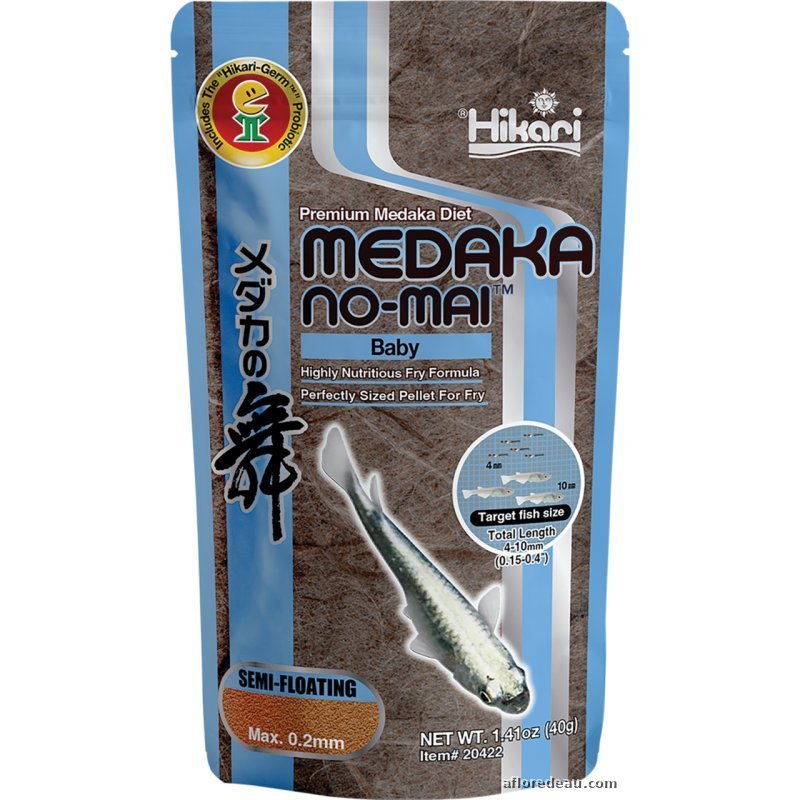
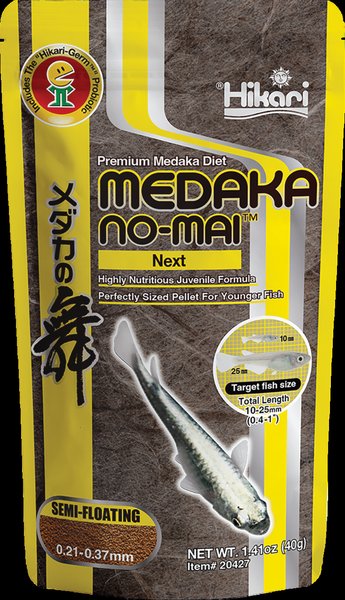
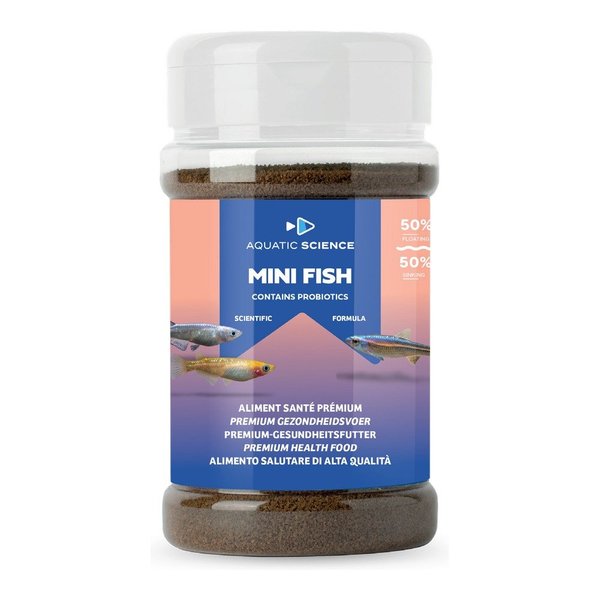
For the powder, choose a food made for this mouth size: Hikari Medaka Baby, 0.2 mm at most, up to 1 cm, then Hikari Medaka Next or Aquatic Science Mini Fish, in 0.3 mm. A minuscule pinch, removed if it is not eaten.
Helpers
- Pond snails and ramshorn snails. These snails “never attack a living medaka” and eat leftovers and droppings, which is useful in a fry tub. Two reservations: in large numbers, their own waste pollutes in turn; and they make dead fry vanish overnight, so mortality is underestimated. One Japanese shop deliberately puts a few ramshorn snails in its fry tubs against leftovers, keeping their numbers down.
- Shrimps. Neocaridina are compatible, but eat a weakened fry lying on the bottom; the larger Caridina japonica eat eggs and fry. No shrimps in the hatching tub.
- Green water. The permanent food of fry outdoors, and the best way not to starve them; indoors, it needs light, and it consumes oxygen at night if it is thick. See green water.
- Plants. A little moss or a floating plant carries microfauna and gives shade; no source credits them with more than that at the needle stage.
Transfers
- To a larger tub: at 5 mm, 1 L per fry; at 7 mm to 1 cm, 2 L per fry, for example thirty fry in 60 L. Tokyo Aqua Garden and one breeder prefer to wait two weeks, until swimming is secure.
- To the adults’ tub: never before 1 cm, “with a well-formed head, in an inverted triangle” says GEX; 1 to 1.5 cm at Tetra; 1.5 cm to be out of reach of the parents’ mouths. At two months, the young eat the eggs themselves.
- How: always with their own water, with a ladle or a pipette, never with a net; temperature equalised beforehand; the new tub seeded with water and gravel from the old one. A new tub “cycled with substrate” does not exist for fry: it is the parents’ tub that is cycled, and it is its water that you carry over.
- Sort by size into two or three classes as soon as the differences exceed double: the big ones eat the small ones.
Survival rate
The Japanese WEB図鑑 considers a loss of 20 to 30% over the first weeks normal. Hime-medaka, in professional breeding, states that “90% and above is not a difficult figure” with a stable temperature, unpolluted water, moderate density and microfauna. Conversely, a Japanese beginner reports thirty hatchings indoors without heating in spring and two survivors: he concludes that “spring eggs are not weak, it is the cold water that makes breeding difficult”. What makes survival fall, in order: temperature swings, water polluted by excess care, density, hunger, and shocks during water changes and transfers.
The case: two-week-old fry that sink
Let us go back over the elements: new bottled mineral water, 10 to 15% changed every day, no filter, nitrites and nitrates at zero, fry that eat then drop to the bottom, lie flat for a day and die with empty stomachs, mostly the bigger ones, pond snails in the tub. What the Japanese sources say about a fry that sinks and no longer rises: “exhaustion from lack of food, or degraded water and ammonia poisoning, or low temperature, or malformation”. And a rule of interpretation: “if a few per cent sink, it is individual, a malformation; if the sinking fry are more and more numerous from day to day, it is the water”. A fry that “tries to rise and falls back” is at the end of its strength.
The picture described ticks three boxes at once. Fresh water every day, sterile, without bacteria, in which the ammonia from fifteen fry fed on powder builds up with nothing to convert it, and which nitrite tests do not see. Daily changes which, at this age, are so many small osmotic and thermal shocks. And, probably, an autumn room below 25 °C, where the fry digests poorly and where the microfauna cannot keep up: it eats, but not enough for its size, and dies with an empty stomach. Why the bigger ones go first, no source explains, and we will not explain it in their place. Parents that are too young are blamed by nobody; late-season eggs are a problem only outdoors, because of the cold, and “in a heated indoor setting, the birth season makes no difference”.
What to do: measure the ammonia; heat to 26 °C and light for ten hours; stop the daily changes, top up only, and siphon the bottom with a pipette; remake the tub with water and a little gravel from the parents’ tub rather than with bottled water; feed four times a day in minuscule amounts, preferably with infusoria or green water in addition to the powder; keep a few snails, not a population. And count the survivors every evening, because the snails will have made the others vanish before morning.
The figures to remember
| Volume | 100 to 500 ml per fry at hatching, 1 L at 5 mm, 2 L at 1 cm; container of 10 L or more, wide and shallow |
|---|---|
| Water | top-up only until 7 mm; a fifth to a quarter until 1 cm; adult regime at 1.5 cm; parents’ water at the start |
| To measure | ammonia, not nitrites |
| Temperature | 25 to 28 °C, daily swing under 5 °C; no growth below 20 °C |
| Light | 10 h a day |
| Feeding | from day 3, 3 to 5 times a day, in minuscule pinches |
| Transfers | large tub at 2 weeks or 1 cm; adults at 1.5 cm; always with the water, with a pipette |
| Survival | 70 to 80% normal, 90% attainable; critical window from day 4 to day 14 |
A breeder we advised in October 2026 gave a demonstration of this: fry of ten to fifteen days that dropped to the bottom and died every day, in 1.5 litres of bottled water renewed daily, with no heating. He moved to 5 or 6 usable litres, added a gentle air stone and a little lava rock from the outdoor tub, and above all a heater set around 26 °C. The losses stopped within a few days; a week later, 30 of the 42 fry that had hatched had passed the needle stage, and the drop test showed only a trace of ammonia. The move to 26 °C was, in his view, the decisive step.
The choice of starting water, dechlorinated tap, rain, bottled or water from the parents’ tub, is detailed with figures in which water for medaka fry.
Frequently asked questions
Do I need a filter or an air stone in the fry tub?
Neither filter nor current at the needle stage. Indoors, one Japanese shop advises very gentle bubbling, with no turbulence, to stop the water going off; the others do without.
Nitrites are at zero, so is my water good?
No. In a new tub with no cycle, nitrites stay at zero because the ammonia is not being converted. Test for ammonia.
Should I remove the pond snails?
Not necessarily: a few clean up leftovers. Remove some if they swarm, and be aware that they eat dead fry, which hides losses.
Do four-month-old parents produce weak fry?
No Japanese source says so. What changes the vigour of the fry, according to GEX, is the lighting of the parents: parents raised in the shade lay transparent, poor eggs, and their fry grow less well.
Sources
- Tokyo Aqua Garden, “メダカの成長を解説” (medaka growth explained), 2022, updated in 2026, t-aquagarden.com; “メダカ稚魚の生存率を上げる方法” (improving fry survival), 2021, t-aquagarden.com; “秋に生まれたメダカを育てる方法” (raising fry born in autumn), 2023, updated in 2026, t-aquagarden.com: no filter, few water changes, 1 L per fry, small tub for the first two weeks, the season does not matter indoors.
- GEX, “メダカが孵化したらすべきたった3つのこと” (three things to do after hatching), gex-fp.co.jp: 20 fry for 2 L then 10, 26 to 28 °C, the parents’ water and gravel, return to the adults at 1 cm, parents’ eggs kept in the shade.
- Hime-medaka, “針子が死ぬ原因は?” (why fry die), “針子・稚魚の水換え方法” (water changes), “稚魚・針子の育て方”, “水温が大事”, “何匹まで?”, hime-medaka.com: temperature first, over-protection, ammonia, osmoregulation, 10 to 20 L, 25 to 30 °C, 90% survival attainable.
- Medakaya En, “針子の育て方”, 2026, “針子・稚魚の水換え”, “死なせない8つのポイント”, medakayaen-ec.com: 5 to 10 L minimum, three rules, a quarter at most, 26 °C, 12 h of light.
- めだかラボ, “針子・稚魚の水換え” (water changes for fry), 2026, medaka-lab.com: proportion rather than frequency, topping up does not dilute, ammonia is colourless.
- Zakkaya Sun, “針子が底にいる原因”, “歩留まりを上げる方法”, “引っ越し時期”, zakkaya-sun.shop: causes of fry on the bottom, 500 ml then 1 to 2 L, ramshorn snails, transfers with a ladle.
- メダカの飼い方.com, “針子が沈む” (fry that sink), 2021, updated in 2026, medaka.papa77.com: the yolk sac is not a swim bladder, the few-per-cent rule.
- Medaka no Yakata, breeding guide, medakanoyakata.jp: settled water, ammonia in a new tub, 10 h of light. Tetra Japan, spectrumbrands.jp: densities, topping up without removing water. メダ活のススメ, medakalog.shop: the day 4 to day 14 window, dead fry eaten by snails and shrimps. めだかやベース, medakayabase.com: pond snails and ramshorn snails. Sakanato, sakanato.jp: two survivors out of thirty in a cold indoor setting.