
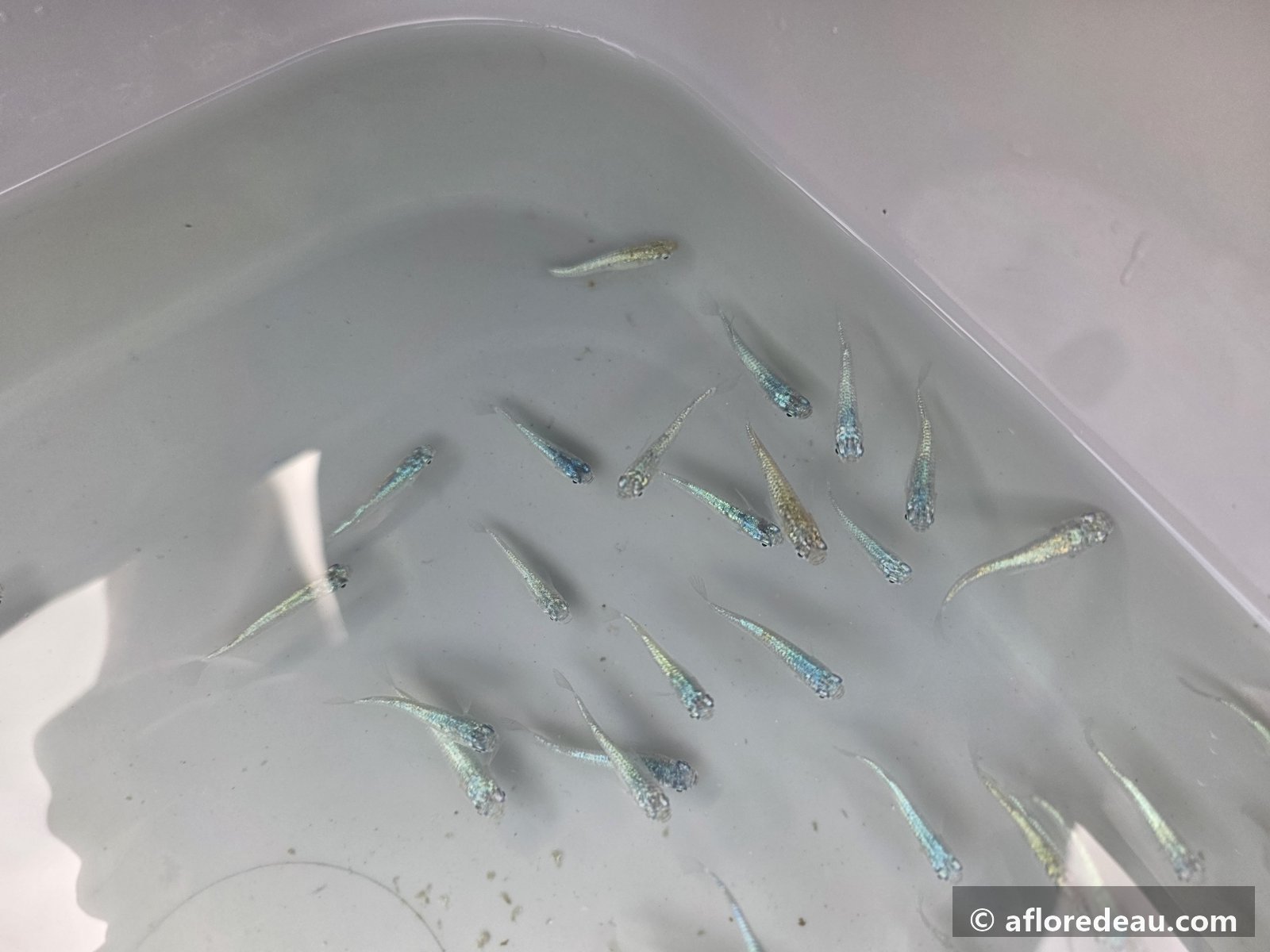
Green water is water loaded with phytoplankton, microscopic algae in suspension. Japanese breeders seek it out because it feeds fry continuously, strengthens colours and stabilises the tank. It is made with sunlight, a few nutrients and, ideally, a glass of green water taken from another tank. It also has its risks, at night and in great heat. This guide explains how to obtain it, dose it, dilute it and keep it from one season to the next.
What green water is
Green water is not dirty water. It contains billions of single-celled algae cells, chlorella and close relatives among the green algae, which float freely and photosynthesise. They live on light, carbon dioxide and the nitrates and phosphates that the fish excrete. Green water is therefore the sign of a tank exposed to the sun and fed. In Japan it goes by the name グリーンウォーター (green water), and breeders regard it as the medaka’s preferred water (t-aquagarden).
It is different from attached algae: green filaments clinging to the walls, brown felt on plants, green dots on the glass. Those algae are a nuisance; green water is useful. See algae in a medaka tank. It is also different from whitish cloudy water, which is a bloom of bacteria, common in a new tank: see cycling.
Why the Japanese seek it out
It feeds the fry. A medaka fry measures a few millimetres at hatching. In its first days, it does not always find a powder fine enough, and hunger is its first cause of mortality. In green water, it has food permanently, at its own size, without anyone intervening. Green water also feeds infusoria and daphnia, which the fry then eat. Japanese breeders note a distinctly better survival rate (t-aquagarden). See raising the fry.
It strengthens colours. Green water implies sunlight, and sunlight brings out the vermilion of a Youkihi or the sparkle of a lamé. Tokyo Aqua Garden observes more vivid colours in adults raised in green water and expects a colour-enhancing effect from well-digested phytoplankton, without separating the share due to ingested pigments from that due to sunlight.
It stabilises the water. Phytoplankton absorbs the nitrates that come from waste. It produces oxygen by day. Moderately green water degrades a little more slowly than clear water in the same tank (t-aquagarden).
It reassures the fish. In opaque water, the medaka feels sheltered from birds and shadows. It is less timid and eats better. The effect on the regularity of spawning is often put forward by breeders, but none of our sources documents it; what is established is a less timid fish that eats better.
Making it
Light. This is the first condition. A tank that receives at least three hours of direct sun a day turns green in one to two weeks in season (t-aquagarden). In the shade, the water stays clear. Indoors, under an LED strip, the water rarely turns green, and that is just as well.
Nutrients. The droppings of a few fish are enough. In a tank with no fish, a pinch of powdered food, or a very light dose of liquid plant fertiliser, starts the culture. No more: excess gives water that turns brown and smells.
A starter. The quickest way is to take a glass or a litre of green water from a tank that already has some, and pour it into the new tank. The colour appears within a few days. t-aquagarden also describes seeding with concentrated commercial chlorella, at 1 ml per 10 litres, in tank water already loaded with nutrients and exposed to sun. Without a starter, exposed water turns green by itself, but it takes two to three months.
Gentle stirring helps: without it, the algae settle on the bottom and the water stratifies.
The right concentration
The Japanese benchmark is simple: you should still be able to make out the bottom of the tank, and the colour is that of bottled green tea, pale brown to pale green (t-aquagarden), not of soup. In practice, put your hand in: if it disappears a few centimetres below the surface, the water is too loaded and you dilute it.
For fry, a light concentration is the right one (t-aquagarden). Very dense water hides them, stops you counting them, and becomes dangerous at night. Always supplement with a fry powder or infusoria: green water is a food base, not a complete meal.
The risks
At night. By day, phytoplankton produces oxygen. At night, it consumes it. In very dense water, on a warm summer night, oxygen drops and the fish suffocate before dawn (t-aquagarden). The signs: medaka gasping at the surface in the early morning. Clearer water, weak aeration or a large open surface rule out this risk.
Heat. Above 30 °C, the medaka is stressed and dense green water makes everything worse: less oxygen, faster decomposition, pathogenic bacteria. The water must not exceed 30 °C (t-aquagarden). In an Atlantic climate the case is rare; in a Mediterranean climate, in July, it is frequent, and you need to shade half the tank.
Collapse. Green water that is too dense ends up short of nutrients or light. The algae die all at once. The water goes from green to brown or grey, smells bad, and everything that decomposes consumes oxygen and releases ammonia. Cloudy, foul-smelling water can also indicate cyanobacteria, which are toxic (t-aquagarden). In both cases, change a third of the water immediately and renew it every day until clear water or a healthy green returns.
Observation. In opaque water, you cannot see a sick fish, or a dragonfly larva, the first predator of medaka outdoors (t-aquagarden). Pass a net through the tank from time to time to check.
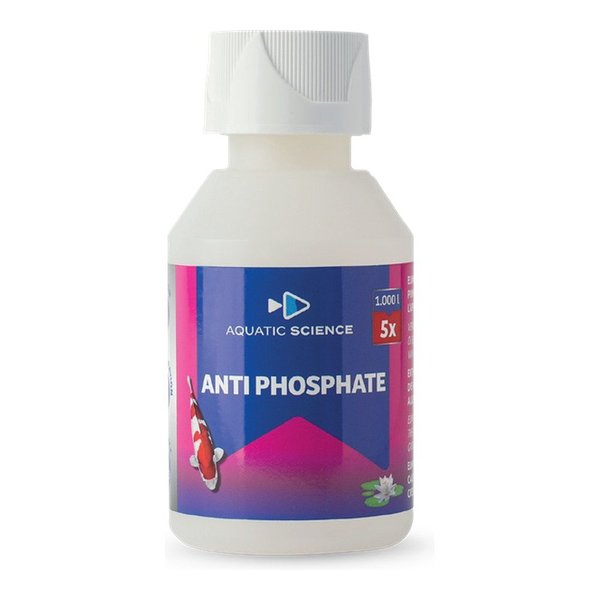
Phosphate binders. A product such as Aquatic Science’s Anti Phosphate is used against filamentous algae in a tank of adults. Avoid it in the tank where you are growing green water to produce fry in quantity: the phosphate it removes is the fertiliser of that green water.
Diluting it
When the water becomes too dense, remove a quarter to a third of the volume and replace it with water left to stand, at the same temperature. You can also reduce the sun by shading. Simpler still, let floating plants win: a cover of frogbit over a third of the surface takes light from the algae and slows the culture. Regular water changes remain the normal method for holding the colour (t-aquagarden). See water changes.
Keeping it through winter
Outdoors, green water fades by itself in autumn: less light, fish eating less, cold water. It does not disappear entirely and starts again in spring. An overwintering tub does not need to be green. To keep a starter culture to hand, fill a transparent bottle or a bucket with dense green water, placed behind a south-facing window, with no fish, with a pinch of food a month. In spring, this starter seeds fry tanks in a few days instead of several weeks. See overwintering and medaka through the seasons.
The key figures
| Sunlight needed | At least 3 hours of direct sun a day (t-aquagarden) |
|---|---|
| Time with sun and nutrients | 1 to 2 weeks; a few days with a starter |
| Time with no starter or nutrients | 2 to 3 months |
| Concentrated chlorella | 1 ml per 10 litres (t-aquagarden) |
| Target concentration | Light green tea; bottom still made out |
| Ceiling temperature | 30 °C |
| Dilution | A quarter to a third of the volume, water left to stand at the same temperature |
Frequently asked questions
Is green water useful in an indoor aquarium?
Rarely. Indoors, you want to see your fish, and the light from an LED strip is not enough to sustain it. Fry raised indoors feed on fine powder and infusoria.
My green water has turned brown and smells bad. What should I do?
It is a collapse. A third of fresh water straight away, then every day until the smell disappears. Feed little in the meantime and watch the fish’s breathing.
Do adults need green water?
No. It benefits them, for colour and calm, but an adult lives perfectly well in clear water. It is the fry that get the most from it.
Can you buy green water?
Concentrated chlorella is sold in pet shops and serves as a starter. The simplest method remains a litre of water taken from a tank that already has some, from a breeder or a neighbour.
Does green water replace food for fry?
No. It provides a permanent base, but you also give a fry powder 4 to 5 times a day. See feeding medaka.
Sources
- t-aquagarden, column “green_water” (making and managing green water), https://t-aquagarden.com/column/green_water
- t-aquagarden, column “greenwater_merit” (advantages and drawbacks of green water for the medaka), https://t-aquagarden.com/column/greenwater_merit
- t-aquagarden, column “medaka_ph” (the water that suits the medaka; green water in 1 to 2 weeks with 3 hours of sun), https://t-aquagarden.com/column/medaka_ph
- medaka.fr fact base (TAG, WEB図鑑): green water sought after in Japan, fry fed 4 to 5 times a day, dragonfly larva first predator.