
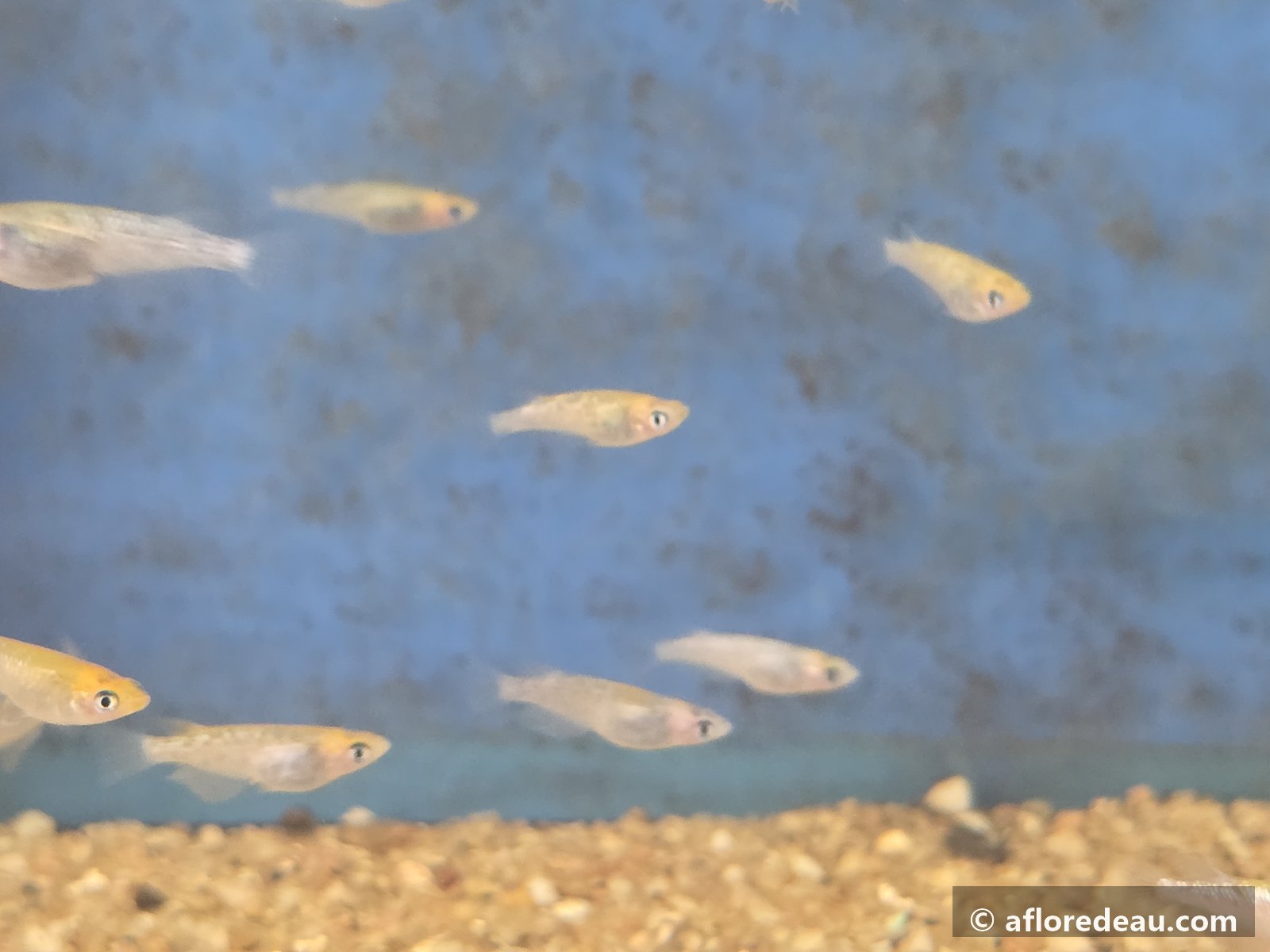
Algae in a medaka tank are normal. They only become a problem when they take over. Each type has its cause: too much light, too much food, a tank that is too new, an imbalance between plants and nutrients. The remedy is almost always the same: less light, less food, more plants, regular water changes, and a few well-chosen algae eaters. Never an algicide.
Green water is not a nuisance alga
Before fighting, you have to tell them apart. Water that is uniformly green, through which you can still make out the bottom, is green water: phytoplankton in suspension, sought after by Japanese breeders to feed the fry and stabilise the tank. You do not fight it, you dose it. See green water. The algae this guide deals with are those that cling to the glass, the plants and the substrate, or that float in filaments. They do not feed the fish, they smother the plants and spoil the view.
Type by type
Green film and green spots on the glass
A green veil that covers the walls within a few days, or hard green spots of about two millimetres, firmly attached (t-aquagarden). Cause: strong, long light, direct sun on an aquarium or an LED strip on for more than 12 hours. This is the least serious alga. Remedy: a scraper or sponge once a week, lighting reduced to 10 to 12 hours, and the tank moved away from direct sun if it is indoors. See indoor lighting. Outdoors, on a tub, the green film on the walls bothers no one and the medaka graze on it.
Filamentous algae
Green threads, fine or in tufts, that cling to plants, edges and the air stone, and end up as floating mats. In Japan they are called aomidoro. Cause: an excess of nutrients, nitrate and phosphate, with plenty of light (t-aquagarden). They are seen mostly in spring in outdoor tubs, when the sun returns before the plants have restarted, and in overfed tubs. Remedy: remove them by hand by winding them onto a stick or a bottle brush, reduce the food, change a third each week as long as they keep returning, and let the plants take over. Outdoors, a cover of frogbit over a third of the surface takes their light. Take care when removing the mats: fry and eggs hide in them. Shake the clump in a bucket of tank water before throwing it away.
Brown algae
A brown, dusty felt on the glass, the leaves and the gravel. These are diatoms. They appear in new tanks, generally in the first few weeks, and in poorly lit tanks (t-aquagarden). They disappear by themselves as the tank matures and the plants grow. Remedy: patience, a little more light if the tank is dark, and a snail or two. Do not increase the food or add fertiliser to “help the plants”: that feeds the next algae.
Blue-green algae
A smooth, blue-green or dark green mat that comes away in patches and smells of earth or mould. These are not algae but cyanobacteria. They indicate stagnant, rich water, often in a corner with no current, with a substrate loaded with waste. They can be toxic; t-aquagarden points out the risk in degenerated green water. Remedy: siphon out the patches, clean the bottom, stir the water a little, change a third twice in the week. A complete blackout of three to five days, with the tank covered on all sides and aerated, pushes back green water and filamentous algae, according to aquascaping references; do not go beyond a week, and then deal with the cause, light or food, otherwise they return. The Japanese source does not detail this type.
The common causes
Algae need three things, like plants: light, nutrients and carbon dioxide. They win when they have more than the plants can use.
- Light. More than 12 to 14 hours a day, or direct sun on an indoor aquarium. Outdoors, light cannot be adjusted: plants and shade compensate.
- Food. This is the most frequent cause (t-aquagarden). Every uneaten crumb becomes nitrate and phosphate. The marker: what is eaten in 2 to 3 minutes, once or twice a day. See feeding.
- Infrequent water changes. Nitrates build up, invisibly, until the algae make them visible.
- Too few plants. A tank without fast-growing plants leaves everything to the algae. Elodea, Ceratophyllum, Najas, Ludwigia indoors, frogbit at the surface. Never water hyacinth or water lettuce, which are banned in the European Union.
- Fertiliser. A medaka tank does not need fertiliser: the fish supply it. A liquid fertiliser added for the plants feeds the algae first (t-aquagarden).
The remedies that work
In order. Reduce the light to 10 to 12 hours indoors. Reduce the food. Change a third of the water each week as long as the algae are advancing (t-aquagarden). Clean the substrate with a siphon, without turning it over entirely. Add fast-growing plants. Remove the algae by hand, without trying to take everything out at once. Then wait: a tank rebalances in three or four weeks, not in three days. See water changes.
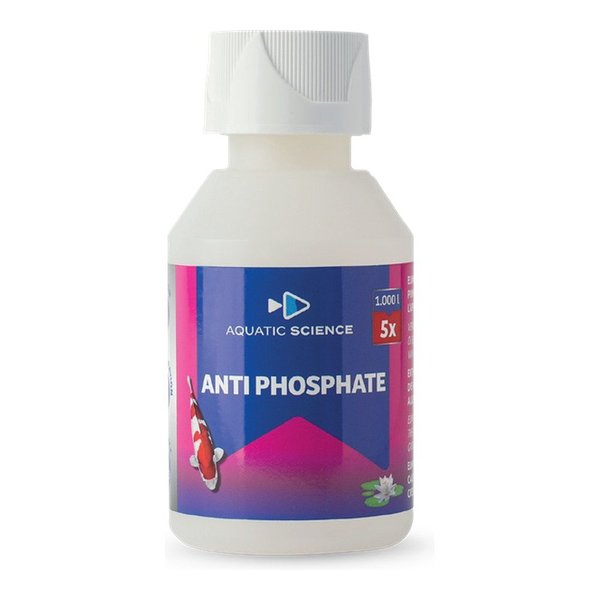
A phosphate binder removes part of the fertiliser that filamentous algae live on. It is not an algicide: it kills neither the algae, nor the plants, nor the fish. Aquatic Science’s Anti Phosphate 100 ml is dosed at 20 ml per 1,000 litres, that is 2 ml for a 100-litre tank. It is complemented by fast-growing plants and regular water changes. One reservation only: if you want to produce fry in quantity, avoid it in their tank, because the green water that feeds them needs that phosphate. See our introduction to the Aquatic Science range.
Compatible algae eaters
No animal replaces the steps above. They finish the job. And not all of them suit the medaka, which lives in cooler water than most aquarium fish.
Snails. Ramshorn snails and bladder snails arrive on their own with plants, eat the green film and brown algae, and withstand winter outdoors. They multiply according to the food available: many snails means too much food. Neritina snails, sold in pet shops, are more effective on the glass and do not breed in fresh water, but they need hard water and at least 20 °C according to breeding fact sheets: for the indoor aquarium, not for a tub outdoors. t-aquagarden cites the ishimaki-gai, close to the Neritina, and the small tanishi, which filter cloudy water. These are Japanese species, and the large tanishi (Cipangopaludina chinensis) has even been banned in the European Union since August 2025; the permitted equivalent is the river snail (Viviparus), see what animals to keep with medaka.
Shrimp. The shrimp Caridina multidentata, known as Amano or Yamato, 2 to 3 cm, is the most effective against filamentous algae (t-aquagarden). It does not breed in fresh water, so there is no invasion. Native to Japanese rivers, it tolerates cold: Tokyo Aqua Garden specifies that it can overwinter outdoors if the water does not freeze, and that it fears above all sudden temperature variations. In mild Atlantic climates such as Brittany, it therefore has its place in a tub; in continental and northern climates, bring it indoors. Neocaridina, the red cherry shrimp, are hardier and breed; adult medaka eat some of the juveniles, which regulates numbers. In both cases, provide hiding places, Java moss or dense tufts.
Fish. t-aquagarden cites the Otocinclus against brown algae and green spots. It is a tropical fish from South America, which needs at least 21 °C according to species sheets, a mature tank and life in a group: reserve it for a heated indoor aquarium, never for an outdoor tub. No algae-eating fish suits an outdoor medaka tub in Europe.
And the medaka itself? It grazes on the film on the walls and the young filaments, but never enough.
What not to do
- Algicides. t-aquagarden advises against them without reservation: they affect plants, invertebrates and medaka, and masses of dead algae use up oxygen and release their nutrients for the next generation.
- The big clean. Emptying everything, scrubbing, refilling with fresh water: the bacterial cycle is broken, and the algae are the first to return. See cycling.
- Cutting all light for long. Three days of darkness are tolerated; a week kills the plants.
- Adding algae eaters without correcting the cause. They starve when the algae recede, or cannot keep up when the algae gain ground.
- Taking snails or shrimp from a pond. Parasites, leeches and dragonfly larvae come with them.
The figures to remember
| Green spots on the glass | About 2 mm, light too strong or too long (t-aquagarden) |
|---|---|
| Indoor lighting | 10 to 12 hours a day outside breeding |
| Food | What is eaten in 2 to 3 minutes, 1 to 2 times a day |
| Water change when there are algae | A third a week (t-aquagarden) |
| Brown algae | New tank, first weeks; disappear by themselves |
| Amano shrimp | 2 to 3 cm, does not breed in fresh water; outdoors if the water does not freeze (mild Atlantic climates), brought indoors in continental and northern climates |
| Rebalancing time | 3 to 4 weeks |
| Algicides | Never |
Frequently asked questions
Are algae dangerous for medaka?
Not directly, except for cyanobacteria. The danger comes from what they reveal: too much food, too much nitrate, an unbalanced tank. A mat of filamentous algae can also trap a fry.
Does a goldfish eat algae?
A little, but it has no place in a medaka tank: it also eats fry, eggs and plants, and it pollutes far more.
Should I remove the snails?
No, as long as they stay few. A snail explosion signals an excess of food; correct the food, not the snails.
The algae come back after every clean. Why?
Because the cause is still there. Cleaning removes the algae, not the light or the nitrates. Act first on lighting, food and water changes.
Sources
- t-aquagarden, column “medaka_tank_algae” (algae in a medaka tank: types, causes, algae eaters, algicides not recommended), https://t-aquagarden.com/column/medaka_tank_algae
- t-aquagarden, column “greenwater_merit” (risk of cyanobacteria in degenerated green water), https://t-aquagarden.com/column/greenwater_merit
- medaka.fr fact base (Kamihata, WEB図鑑, TAG): food eaten in 2 to 3 minutes, 8 to 10 hours of light outside breeding, recommended plants, frogbit as the only floating plant to recommend.