
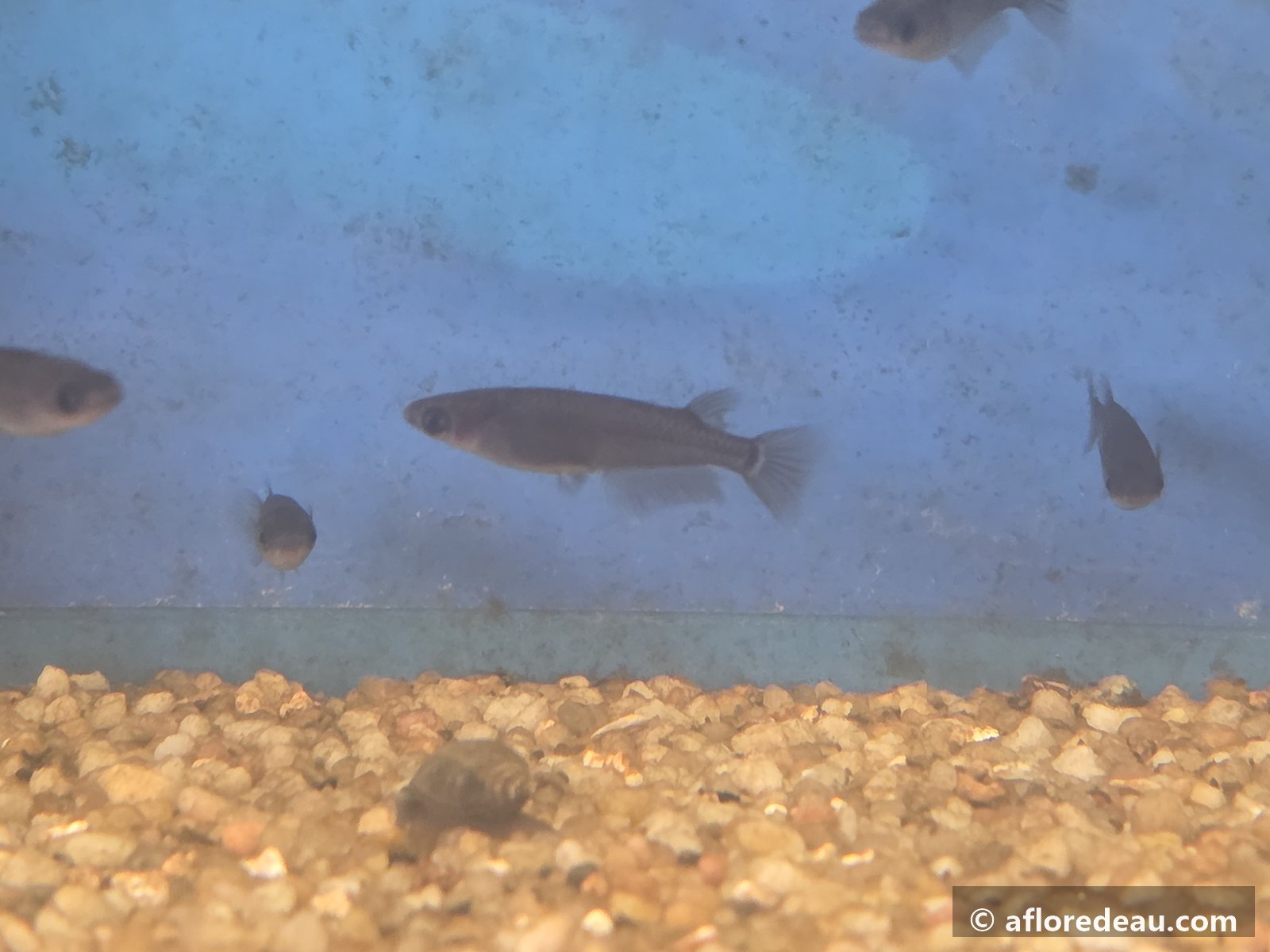
Yes, an indoor medaka tank needs lighting, unless it receives daylight from a nearby window, and even then lighting on a timer does better. This is not a matter of decoration: light sets the fish’s clock, triggers or stops spawning, brings out the colours and feeds the plants. A white LED lamp of 10 W per 10 litres, switched on 10 to 12 hours a day at fixed times, is enough. The rest is a matter of adjustment.
What light does to a medaka
The medaka is a fish of rice paddies, ditches and shallow ponds. In the wild, it lives in full light, a few centimetres below the surface. Its whole functioning is set to the day. Japanese breeders describe four effects, which we also observe.
The internal clock. A medaka has a 24-hour rhythm: it eats, swims and rests according to the alternation of day and night. A light that switches on and off at fixed times stabilises this rhythm. A tank in a dark room, or lit at random by people passing, gives apathetic fish, which eat less and defend themselves less well against disease.
Spawning. This is the clearest effect. Day length is, with temperature, the trigger for reproduction. From 13 to 14 hours of light a day and water at 20-25 °C, females spawn almost every morning. Below 12 hours, spawning slows and then stops. Indoors, it is therefore you who decide the season: a tank lit for 14 hours spawns in January, a tank lit for 9 hours rests in July.
Colours. A medaka seen under a frank white light shows what it is: the vermilion of a Youkihi, the blue of a Neptune, the luminous band of a Miyuki. Under a yellow or weak light, everything looks dull. Light does not create colour, feeding and genetics do, but it reveals it, and the sun, for its part, strengthens it.
Plants. Without light, no plant survives. Yet plants are the spawning support, the hiding place of the fry and the first filter of the tank. A planted tank without lighting loses its plants within a few weeks.
What indoors will not replace
It has to be said honestly: the best light for a medaka is the sun. Japanese breeders keep them outdoors whenever they can, and our breeding tubs at Lesneven are outdoors from March to October. The sun brings what no LED gives: ultraviolet that contributes to vitamin synthesis and strengthens immunity, an intensity ten to a hundred times greater that brings up the colours, and green water, the phytoplankton that feeds fry and stabilises the water. It also brings the seasons: shortening days and cooling water put the fish to rest, and this winter rest is part of its life. A medaka kept all year at 22 °C under 14 hours of light spawns non-stop, wears out faster and lives less long.
Indoor keeping remains the right choice for watching your fish, for delicate varieties such as the Daruma, for growing on late-born fry, or when you have no garden or balcony. It simply requires giving the lamp the role of the sun, and giving it seasons.
Which lamp
A white aquarium LED strip, nothing more complicated. Three criteria.
Power. Kamihata’s benchmark is simple: about 10 W of LED per 10 litres of water. For a tank of 20 to 30 litres, a strip of 15 to 20 W or 800 to 1,000 lumens is plenty. More brings nothing to the fish and feeds algae.
Colour of the light. A neutral to cool white, between 6,500 and 10,000 kelvin, renders colours without distorting them and suits plants. Very blue strips flatter Miyuki and Neptune but dull the reds; very warm strips do the opposite. Adjustable models let you choose, but a plain white is the best starting point.
The timer. This is the most important accessory, more than the lamp. A programmable socket costing a few euros switches on and off at the same time every day, and it is this regularity that matters to the fish. A tank lit “when you remember” has no rhythm.
How many hours
| Objective | Duration per day | Notes |
|---|---|---|
| Routine maintenance | 10 to 12 hours | The fish is active, plants grow, algae stay contained |
| Breeding | 13 to 14 hours | With water at 20-25 °C and two meals a day |
| Rest, “artificial winter” | 8 to 9 hours | Spawning stops; temperature and feeding are also reduced |
| Beyond 14 hours | to be avoided | Algae, fish with no rest, no gain in spawning |
The daylight in the room counts towards the total. A tank near a window already receives several hours of daylight; adjust the lamp to top up, not to add. And the night must be dark: no mood lamp left on permanently. If you want to watch your fish in the evening, a weak blue LED for an hour does not disturb them; a white light all night does.
The window: good idea or trap
A tank placed near an east- or north-facing window receives a good indirect light and can do without a lamp for part of the year. Three reservations. Day length varies from 8 hours in December to 16 hours in June: without a lamp, your fish live to the rhythm of the seasons, which is no bad thing, but you no longer control spawning. Direct sun behind glass heats the water very quickly in a small volume, and a 20-litre tank can exceed 30 °C on a July afternoon, which is the limit for a medaka. Finally, direct sun turns the glass green and, in the long run, damages the silicone seals. The right place is therefore indirect light, never full sun, and a lamp on a timer to smooth out the seasons.
Giving an indoor tank seasons
This is what distinguishes careful keeping from a simple aquarium. We advise following the outdoor calendar roughly: 13 to 14 hours of light and 22 to 25 °C from April to September, then, over two to three weeks, going down to 9 hours of light and letting the room cool to 15-18 °C from October to February, reducing feeding to one meal a day and then every other day. The fish stop spawning, rebuild their reserves, and start again in spring with more abundant clutches. A heater is not necessary as long as the room stays above 10 °C. The detail of resuming and stopping feeding is in the overwintering guide.
The mistakes seen most often
- Too many hours. A lamp on from waking to bedtime, 16 hours, gives algae on every pane and fish that never rest.
- No timer. Hours that change every day break the rhythm. The timer costs less than the lamp and matters more.
- A coloured mood lamp. Red and blue LED strips sold for effect do not render colours and do not suit plants.
- Full sun behind the glass. Overheating and algae. Indirect light only.
- Light at night. No night light on the tank.
- Waiting for spawning without lengthening the day. Warm water is not enough: without 13 hours of light, the females do not spawn.
The key figures
| Power | about 10 W of LED per 10 L (Kamihata), that is 800 to 1,000 lumens for 20 to 30 L |
|---|---|
| Colour | neutral to cool white, 6,500 to 10,000 K |
| Routine duration | 10 to 12 hours, at fixed times |
| Spawning | 13 to 14 hours and 20-25 °C |
| Rest | 8 to 9 hours and 15-18 °C |
| Night | dark, no night light |
| Window | indirect light yes, direct sun no |
Frequently asked questions
Can my medaka live without a lamp in an ordinary room?
They survive, but they live badly: less active, less colourful, no spawning, and the plants die. A small LED strip on a timer changes everything for a few tens of euros.
Does the lamp heat the water?
An LED, hardly at all. This is an advantage over old tubes. The water of an indoor tank follows the temperature of the room.
Do you need a special plant lamp?
Not for the plants kept with medaka, elodea, Java moss, Anubias, Cabomba: an ordinary white strip is enough for them. “Plant” strips are for demanding planted aquariums.
My glass is turning green. What can I do?
Cut the lighting by an hour or two, move the tank away from the window, and add a few snails or shrimp. A little algae on the bottom is not a problem, the medaka graze on it.
Does a blue light in the evening disturb the fish?
Weak and brief, no. It is the only case where you can light the tank at night. An hour at most, then darkness.
Sources
- Tokyo Aqua Garden, メダカのLED照明: lighting duration and recommended lamps, t-aquagarden.com/column/medaka_led
- Tokyo Aqua Garden, 水槽用照明の必要性: why light an aquarium, t-aquagarden.com/column/led_necessity
- Tokyo Aqua Garden, 屋外飼育: what the sun provides, t-aquagarden.com/column/outdoor_breeding
- Kamihata, 趣味のメダカ − 飼育のしかた: 10 W for 10 L, 8 to 10 h outside breeding, 13 to 14 h for spawning
- À Flore d’Eau observations, Lesneven