
How many times a day should you feed medaka? The answers you find range from once a week to five times a day, and they are all right, because none of them holds without the water temperature. A medaka has no stomach: it stores nothing, it digests as it goes, and below 10 °C it hardly eats at all. Feeding therefore starts with reading the thermometer, then giving what will be eaten in two or three minutes, at a time when the fish can digest before nightfall. Here is the full rule, as practised by Japanese breeders and by the food maker Hikari, with quantities, times, foods, mistakes, and the special case of fry.
The basic rule: thermometer first, then the clock, then the amount
| Water | Meals per day | Amount and time |
|---|---|---|
| below 10 °C | none | The fish is at rest and no longer looks for food; whatever is given sinks and decomposes. One Japanese school, that of the maker GEX, allows a pinch eaten within twenty seconds at midday on sunny days when the water climbs towards 10 °C; the other, that of breeders in Ehime and Tokyo, gives nothing from December to March. When in doubt, nothing. |
| 10 to 15 °C | one meal every two or three days, or one a day indoors | Very little, around midday, on days when the water has warmed up. In spring, start again with a light, easily digested food at half dose for a week before moving on to richer foods. |
| 15 to 20 °C | one | Slightly less than they would eat, finished within two minutes, when the water is warmest, around 3 pm. Below 18 °C, cut back whatever the food. |
| 20 to 25 °C | one to two | The easiest range: eaten within two or three minutes, in the morning once the water has warmed, and in the late afternoon. |
| 25 to 30 °C | two to three, up to four in the spawning season | Early morning and late afternoon, never in the hottest hours, the last meal two to three hours before sunset; small frequent doses rather than one large one. |
| above 30 °C | one, or none | The fish eat less and warm water copes badly with leftovers: cut back, or skip. Around 35 °C they hardly eat at all. |
The amount is judged with a stopwatch, not a spoon: what is eaten in two or three minutes, and nothing that sinks to the bottom. Hikari nevertheless gives a figure for those who want to weigh: for twenty adults above 20 °C, 0.12 g of pellets a day, that is 6 milligrams per fish, about the size of its eye. Laboratories, which feed to satiation to get fish spawning at two months, reach 5% of body weight a day, spread over five to seven meals.
The time of day
A medaka digests in about three hours according to a Tokyo breeder, two according to GEX. These are breeders’ estimates that nobody has measured, but the idea holds. Feed when the water is warmest, when the fish is active and really eats, and early enough that nothing is left on the bottom by nightfall. No meal at dawn, when the water is at its coldest; no meal at dusk, when the fish slows down in the evening chill and whatever it leaves stays at the bottom. In the morning, wait until the water has warmed, ideally to 20 °C or more; in summer that means early, as the afternoon is too hot; in spring and autumn it is rather the middle of the day, between noon and 3 pm, when the water is at its peak. Feed at the same time every day: the fish get into the rhythm, and an hour either way changes nothing. All of this is read on a thermometer, see reading the temperature of a medaka tub.
Before winter: when to stop, and how to decide
In Japan, two schools disagree about when to stop feeding before winter, the 餌切り (esagiri): some stop when the water drops below 15 °C, others below 10 °C. The author of the ほぼメダカ (hobomedaka) blog, who stops at 10 °C, notes that between 10 and 15 °C many fish still come up to eat, and that both schools overwinter their fish successfully: the medaka copes with either. The rule we follow is the one in the afloredeau.com care guide: feeding stops completely once the water stays below 10 °C, read in the morning.
The morning, not the afternoon. Japanese breeders often reason on the day’s maximum, under clear winter skies where the water warms markedly in the afternoon. An autumn in western Europe is greyer: the water can spend eighteen hours out of twenty-four below 10 °C and touch 12 °C for an hour in the middle of the day. The morning thermometer gives the real floor; a min-max thermometer gives both figures at once, see reading the temperature of a medaka tub.
How long the fast lasts depends on where you live. In France, where our regional calendars come from, the full stop falls at the end of October in the east, with feeding resuming towards the end of March: five months without a meal. In Brittany it runs from December to mid-March, and around the Mediterranean from mid-December to February, with a pinch on mild days. The colder and longer your winter, the longer the fast, and the more reserves the fish must have going into it, which is settled in September and October.
Who stops earlier, or comes in. Three cases do not play with the threshold: late fry under 2 cm, which have few reserves and winter better under cover; fish that are already thin, for which one more meal at 9 °C will change nothing, see the medaka that is losing weight; and the delicate varieties, Daruma, longfin, albino, see varieties that should not winter outside.
The borderline day. When the water hovers around the threshold, look at the fish. A medaka sitting still on the bottom will not eat what you throw in. A medaka that rises into the top ten centimetres as you approach is still active. Offer it a ridiculously small amount, what fits on the tip of a toothpick for twenty or so adults, and watch for thirty seconds. If nothing is taken, remove the flakes with a fine net and do not try again for a week.
Why we stop. You often read that below 10 or 15 °C the medaka “gets indigestion” and dies of it. The ほぼメダカ blog looked into what lies behind this: no measured digestion time in the medaka, no described symptom, no established threshold. That digestion slows in the cold is certain; that it turns into indigestion has never been shown in this species. The rule does not change, but its real reason is simpler: below 10 °C the resting medaka no longer looks for food, and what you give ends up on the bottom, where it decomposes in water that the cold cleans poorly. Stopping protects the water. The other causes of autumn deaths, easier to check than indigestion, are in dead medaka: the causes.
What: floating, sized to the mouth
The medaka’s mouth points upwards: it feeds at the surface, and a fry, which cannot dive, eats only what floats. Food that sinks is food wasted, rotting on the bottom. So choose floating flakes or pellets, with the grain size following the size of the fish.
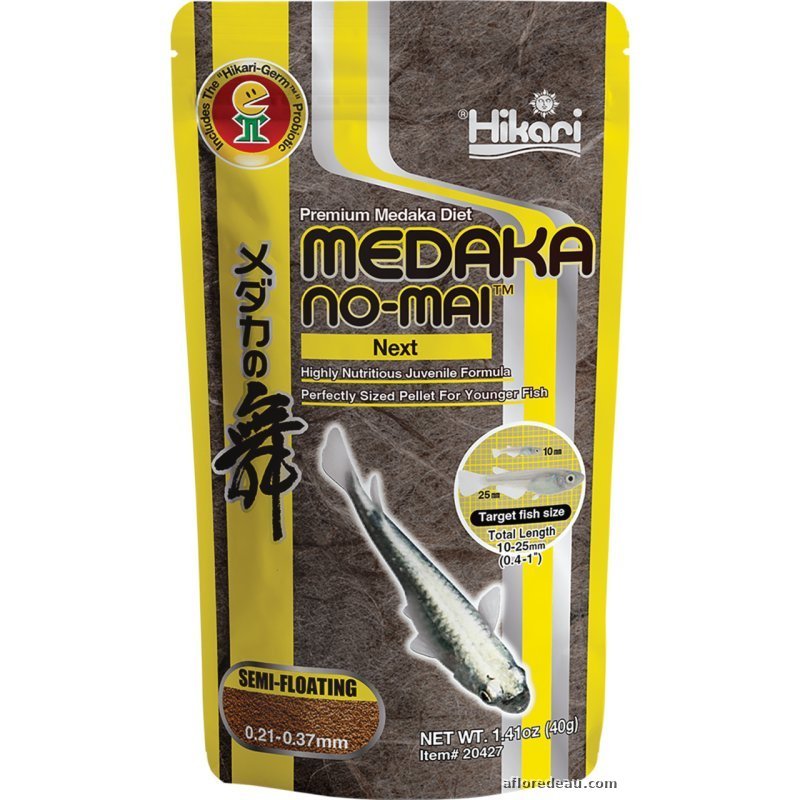
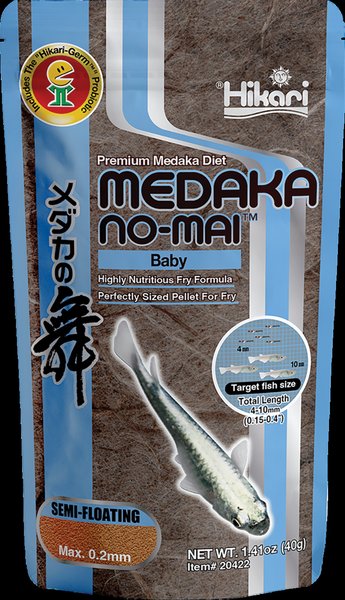
- Up to 1 cm, fry: a powder of 0.2 mm at most, the size of their mouth. In our shop, that is Hikari Medaka Baby.
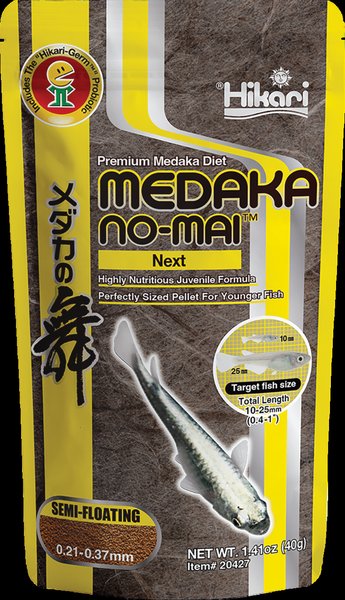
- From 1 to 2.5 cm, juveniles: a grain of 0.2 to 0.4 mm. Hikari stresses this step at 1 cm, where fry powder gives way to a grain matched to the mouth; that is Hikari Medaka Next.
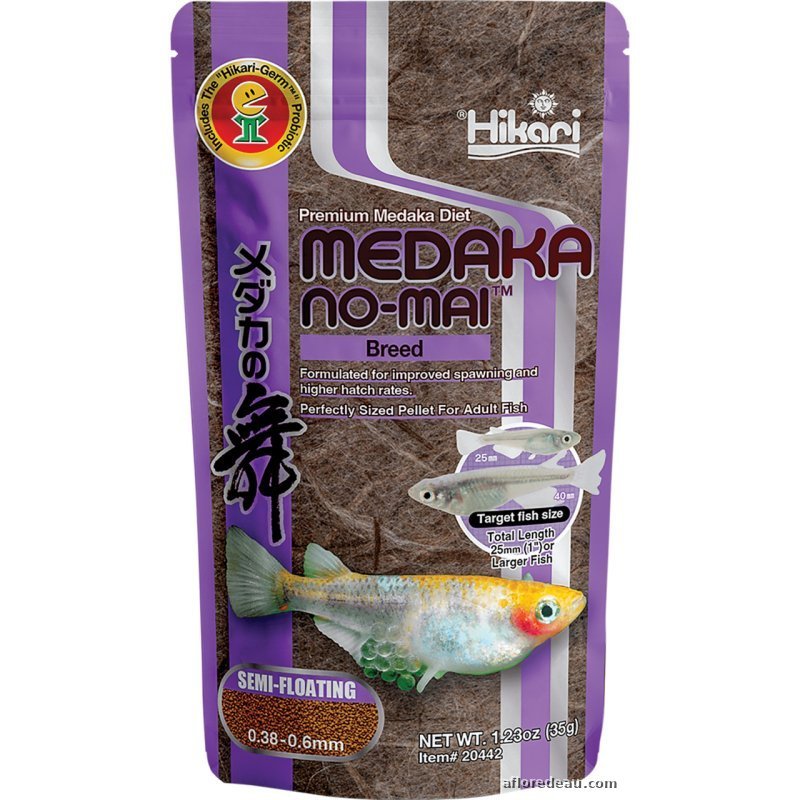
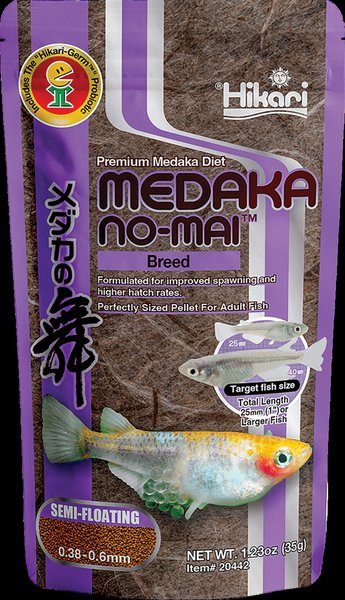
- Adults, from 2.5 cm: a grain of 0.4 to 0.7 mm. For breeders in season, the richer spawning food, Hikari Medaka Breed.
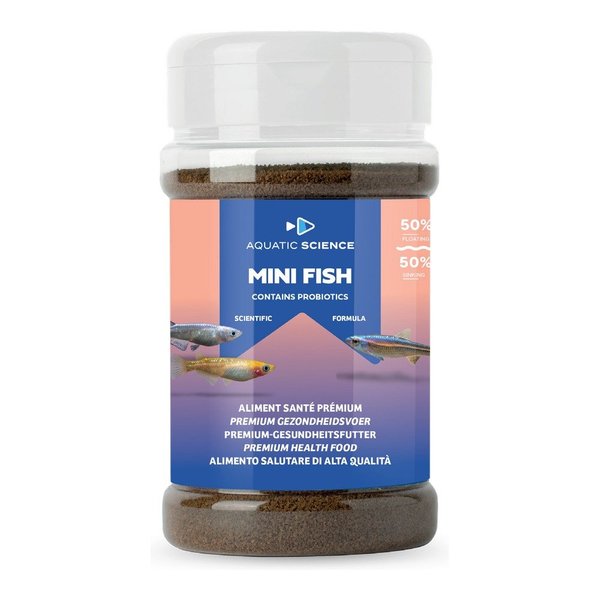
For the 2027 season, Aquatic Science is bringing out a food for small pond fish, Mini Fish: a 0.3 mm grain suited to juveniles of 1 to 2.5 cm, which adults eat too. Half the grains sink: in a tub of medaka only, give smaller pinches and keep an eye on the bottom. Its composition is detailed in our presentation of the Aquatic Science range for small tubs.
Flakes or pellets? Weight for weight, flakes take up four times the volume, float for a long time and are easy to digest: they suit the keeper who feeds little and often. Pellets are more nourishing per mouthful, and they are what you use to grow fish on or bring them into spawning; when switching from flakes to pellets, halve the pinch. A pointer from GEX to tell whether a food suits: short, thick droppings mean a rich food that is a little heavy to digest; long, thin ones, a digestible but lean food.
The spawning foods in the Japanese Hikari range contain 50 to 51% protein and 10 to 11% fat, with a deliberately slightly larger grain and fatty acids which, according to the maker, affect the number of eggs and the hatching rate; the instructions say at least two to three meals a day, in small doses. A breeder in Ehime adds the other side: a female stuffed with fatty food develops a fatty liver, her ovaries shut down and she stops laying. For breeders: high in protein, moderate in fat, and never to satiation.
Live food and green water
- Paramecia, 0.2 mm, are the first food for fry, alive and non-polluting; they are cultured in a bottle with a yeast tablet, in the shade, in four to seven days. Laboratories give them from hatching.
- Newly hatched brine shrimp take over from the fourth day in some lines, from about a week in others; laboratories switch to brine shrimp as soon as possible, at 150 to 300 per fish per meal.
- Daphnia, too large for newborns, feed month-old juveniles and fatten adults outdoors, where they breed in the tub; indoors, the filter sucks them up.
- Green water is a permanent food that clearly raises fry survival, and it absorbs surplus powder; but it does not replace meals, and when too dense it suffocates the tub at dawn. See green water.
- Bloodworms and tubifex, frozen or freeze-dried: rich and fattening, to be given as a supplement to a dry food and never on their own, and put back in the freezer straight away. Fish that acquire a taste for them then turn their noses up at pellets.
A winter trap: brine shrimp hatched in warm salt water, or paramecia cultured in the warm, poured into a tub at 8 °C, die and pollute. Live food is given in the live-food season.
Fry: hunger is the first cause of death
Japanese breeders agree: medaka fry die of hunger before they die of disease or bad water. They have neither stomach nor reserves, they feed poorly in the first seven days, and three days without food indoors is enough to kill them. For the first two days the yolk sac feeds them; from the second or third day you feed, and you feed often: three to five meals a day, five or more according to Hikari and the laboratories, in tiny amounts, eaten while the powder is still floating, with leftovers removed with a pipette five minutes later. The first month shapes the body: a fry well fed from hatching to two weeks becomes a fish that survives and spawns at two months; a fry fed late and little stays small and dies more often. Two litres for about twenty newborns, 25 to 28 °C, no current, few water changes in the first two weeks: the details are in raising fry indoors, and the choice of water in which water for medaka fry.
The mistakes
- Too much. This is the commonest and most serious mistake: leftovers sink and rot, ammonia rises, the water clouds, filamentous algae spread. An overfed fish grows too fast, reaches puberty with immature ovaries, lays clear eggs and lives less long. After an excess: one or two days with nothing, leftovers removed, a third of the water changed, then feeding resumed at half dose.
- In cold weather, or just before a cold rain, a typhoon in Japan, a storm in Europe: photosynthesis stops, oxygen drops, and so does digestion.
- Too rich in spring: a fish coming out of winter digests it badly and develops fatty lumps under the skin. Start again with a digestible food once the night minimum holds at 10 °C, and build up over a week.
- Growing fish by increasing the dose: fish grow by increasing the number of meals, not their size.
- Feeding before going away. A healthy adult fasts for a week without harm, two if it is well covered; do not stuff it the day before, change a third of the water and go. Automatic feeders do more harm than good to adults; for fry and thin fish, green water and daphnia in an outdoor tub are better than a machine. Before transport, breeders fast the fish so that the bag does not fill with ammonia, and do not feed on the day of arrival.
The figures to remember
- Below 10 °C: nothing. 10–15 °C: one meal every two or three days. 15–20 °C: one a day. 20–25 °C: one or two. 25–30 °C: two to three, up to four when spawning. Above 30 °C: cut back.
- Eaten within two or three minutes, nothing sinking; 6 milligrams per adult per day according to Hikari.
- Not at dawn, not at dusk; last meal two to three hours before nightfall.
- 0.2 mm powder up to 1 cm, a 0.2–0.4 mm grain up to 2.5 cm, 0.4–0.7 mm after that.
- Fry: from the second or third day, three to five meals a day, leftovers removed five minutes later.
- A healthy adult can fast for a week; never stuff fish before going away.
Frequently asked questions
The water is 14 °C in the morning and 20 °C in the afternoon in April. Do I feed?
Yes, once, around 2 or 3 pm, slightly less than they would eat, with a digestible food. If the morning is below 10 °C, no.
My medaka rush at the food and beg for more. Should I give more?
No, they always do that. The amount is judged by what is left after three minutes and by the state of the water, not by their eagerness. To grow them on, add a meal, not more food.
I am away for ten days in August. What should I do?
Change a third of the water the day before, no meal on the day you leave, a net against predators and some shade. Well-fed adults will last ten days. For fry, an outdoor tub of green water with daphnia, or a neighbour with one dose prepared per day, eaten within two minutes.
Sources
- Kyorin (Hikari), “メダカの飼い方” (keeping medaka) and the product sheets of the medaka food range, kyorin-net.co.jp: 0.12 g a day for twenty adults, five or more meals for fry, feeding stopped below 12 °C, grain sizes from 0.2 to 0.7 mm, spawning foods at 50–51% protein; monthly outdoor calendar.
- Murata K., Kinoshita M., Naruse K., Tanaka M., Kamei Y., Medaka: Biology, Management, and Experimental Protocols, volume 2, Wiley, 2020, chapter 1, publisher’s excerpt catalogimages.wiley.com: paramecia from hatching, brine shrimp from the fourth day, 150 to 300 per meal, five to seven meals a day, rations in milligrams per fish; Davis C. R., Okihiro M. S., Hinton D. E., Aquatic Toxicology 60, 2002: a ration of 3–4% of body weight slows growth.
- GEX, “メダカ飼育に一番重要な「エサ」のポイント” (the essentials of feeding), supervised by Tomatsu Tomomi, gex-fp.co.jp: upturned mouth, floating food, one minute when spawning, droppings as an indicator, four meals for fry, a decisive first month; “メダカの屋外飼育の月別ポイント” (outdoor keeping month by month), gex-fp.co.jp: the midday pinch in winter.
- Tokyo Aqua Garden, “メダカはエサ無しで何日耐えられるのか” (how many days can medaka go without food), t-aquagarden.com: three hours of digestion, last meal around 3 pm, feeding stopped below 10 °C, a week’s fast; “プロがすすめるメダカが食べるエサ7選” (seven foods recommended by professionals), t-aquagarden.com; “メダカの稚魚の育て方” (raising medaka fry), t-aquagarden.com.
- Medakaya-en, “夏の餌やり” (summer feeding), 2026, medakayaen-ec.com; “稚魚の餌” (food for fry), 2026, medakayaen-ec.com: hunger, the first cause of death in fry; “冬の室内飼育” (keeping indoors in winter), 2025, medakayaen-ec.com.
- THE AQUA LAB, “メダカの餌やりは1日何回” (how many meals a day), 2026, practical-aqualabo.com: table by temperature, 0.1 to 0.2 g for ten adults, time slots, recovering after overfeeding.
- Hime-medaka, “餌切りのタイミング” (when to stop feeding), “飽和給餌” (feeding to satiation), “室内飼育と飽和給餌”, “雨の日の餌” (food on rainy days), “留守中の餌” (food while away), hime-medaka.com: enzymes below 10 °C, fatty liver in overfed females, one to two weeks’ fast, live food and cold tubs.
- メダカの飼い方.com, “餌の量” (amount of food) and “餌の与えすぎ” (overfeeding), medaka.papa77.com: waiting for the water to warm, overfeeding and early puberty; 日淡といっしょ, “ゾウリムシの培養” (culturing paramecia), nittanwith.com; “自動給餌器は必要か” (is an automatic feeder worth it), nittanwith.com.
- ほぼメダカ, “結局、餌切りは何℃?” (so, at what temperature should you stop feeding?), hobomedaka.com, and “メダカって本当に消化不良を起こすのか?” (do medaka really get indigestion?), hobomedaka.com: stopping at 15 or 10 °C, no measurement of digestion and no description of indigestion in the medaka.