
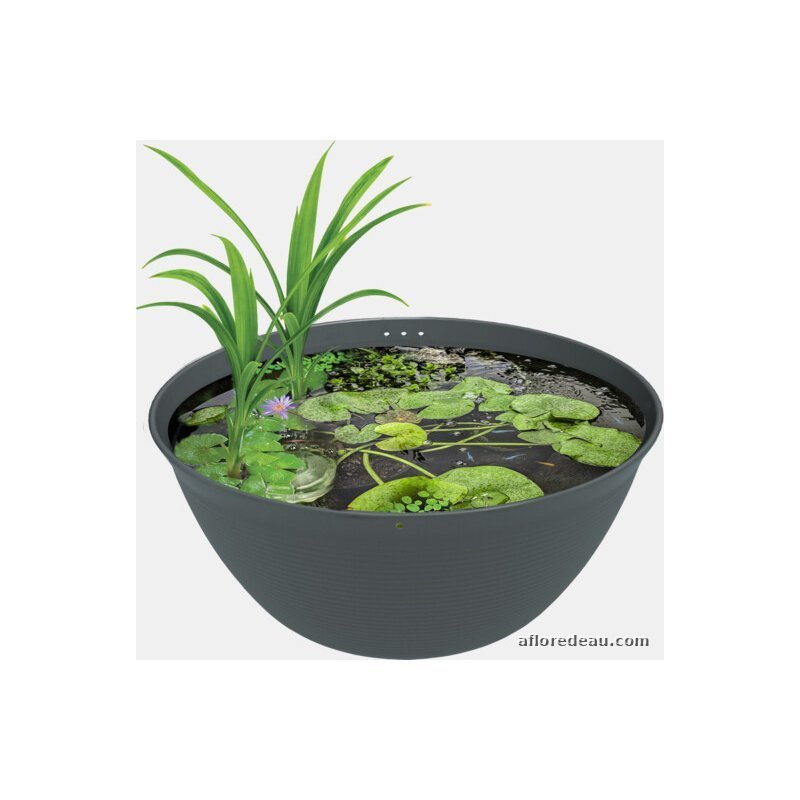
In Japan, the winter tub of medaka breeders is neither a pond nor an aquarium: it is the fishmonger’s polystyrene box, picked up for free and covered with a board. It insulates, it costs nothing, and it can be found everywhere. But it insulates in both directions, it crumbles in the sun, and a closed lid does more harm than frost. Here is what Japanese breeders have learned from it, what physics says about it, how to find one in Europe, and the two alternatives when you have none: the tub within a tub, and glued-on boards.
What a tub loses, and where
A medaka tub standing outdoors loses its heat by three routes: the walls, the bottom and the surface. Expanded polystyrene is 98 % trapped air; its thermal conductivity is 0.03 to 0.04 watt per metre per kelvin, against 0.1 to 0.2 for the polypropylene of plastic tubs and 0.5 to 1 for damp soil. A 3 cm polystyrene wall insulates some fifty times better than the 3 mm wall of a plastic tub; this is a calculation, not a measurement, but the order of magnitude is right. The bottom counts too: standing on soil, a plastic tub exchanges with ground that, in winter, is colder than it is at the surface and warmer at depth.
That leaves the surface, and it dominates. On a clear night, a body of water radiates 70 to 95 watts per square metre towards the sky, against 10 under a layer of low cloud, and it is this radiation that freezes the surface even when the air stays above zero; wind adds evaporation and convection. A polystyrene tub without a lid keeps its walls warm and freezes from the top all the same. Hence the rule given by a Japanese breeder: the most important thing is not the wall, it is stopping the surface from touching open air.
Polystyrene in winter: what it does, and what it does not
Japanese breeders are unanimous in recommending it, from Tokyo to Ehime: at equal volume, it is the material that gives the smallest temperature range, and a covered polystyrene tub measures slightly warmer than a plastic tub, a water-lily pot or an aquarium standing next to it. A Japanese local authority even published the work of a schoolchild who had compared three containers for six years and concluded that the polystyrene one, which does not conduct heat and is not exposed to the outside air, kept a constant water temperature. No series of numerical measurements exists, however; keep the idea, not a number.
Two reservations, which the same breeders state. Insulation works both ways: during a cold snap without sun, a polystyrene tub holds on to the cold it has taken and its surface freezes more easily than that of a neighbouring plastic tub that warms at the first ray; and once ice has formed, it melts more slowly. So place it in the winter sun, not in the shadow of a wall. And in spring, it lags behind: at the end of April, with 22 °C air, one breeder measured 16 °C in his polystyrene against 18 to 23 °C in his plastic tubs. The fish come out of winter later in it, which is an advantage against the misleading warm spells of February, and a drawback in April.
The lid, part open
- Never closed. A sealed lid makes a greenhouse: the water warms during the day, the fish become active without eating, and then the next cold snap catches them weakened. Japanese breeders leave a third to a half open, or cut a hole with a knife, or drill small holes in the sides.
- Polystyrene too, preferably: the lid of the box insulates as much as its walls. A corrugated sheet or a screen does the same job against night radiation and cold rain.
- The floating board: a piece of polystyrene laid on the water stops ice forming beneath it, and it is also onto this that you pour the top-up water, so as not to stir the warm water at the bottom. Loose pieces that the wind moves about break the forming film of ice without electricity.
- Oxygen: breeders do not agree among themselves, some saying that cold water holds enough for motionless fish, others that a closed tub can suffocate. Opening a third settles the question.
Polystyrene in summer
The same tub slows the afternoon rise: breeders report less than 2 °C of daily variation and water below 28 °C with 35 °C air, and count it among the basic measures that together gain 2 to 3 °C. But water that has heated up also cools more slowly at night in it. So combine it with shade, and with colour: white or light in summer, black or dark in winter to catch the sun; in spring, colour makes no difference, a breeder measured 19 °C in a white tub against 20 in a black one. If you paint, use water-based paint only, and never the inside: oil paint dissolves polystyrene. The detail of summer protection is in floating plants and shade.
The double tub and glued-on boards
You do not always have a box of the right size, and a black tub shows off the fish better than a white one. Two solutions do the same job.
- The tub in the box: the plastic tub, the Medaka Bowl for example, stood inside a larger polystyrene box, which becomes the outer insulating layer, with a lid on top. You lose volume: an 8-litre box takes only a 4-litre tub, because the walls are several centimetres thick. In snowy regions, breeders even double the box.
- Glued-on boards: polystyrene boards on the bottom and sides of a plastic tub give, say Japanese breeders, the same effect as a box. Fit them in autumn, not in midwinter when the fish are asleep and must no longer be disturbed.
- The ground: raise the tub on wedges or a slatted base, so as not to exchange with frozen ground; a polystyrene tub can stay on the ground, its base insulates.
Half-burying, often advised for ponds, appears among Japanese breeders only as a summer measure, and without a figure. For a medaka tub, the box or the boards do as well, and can be moved.
Frost, in an insulated tub or not
The rules do not change with the material. A tub with at least 15 cm of water, 20 to 30 cm where hard frosts occur, and 60 litres preferably. Surface ice is left in place: it insulates, and breaking it mixes the warm bottom water, which sits at around 4 °C, with the icy water above. There is one exception, well put by a breeder from Ehime: in a tub that is too shallow, the bottom drops below 1 °C and the fish die; there, remove the ice and top up the level with water at a similar temperature. What kills is complete freezing, never the morning film; a breeder in central Japan lost whole buckets frozen to the bottom in January 2025, and nothing in his covered boxes.
Finding a box in Europe, and making it last
The polystyrene fish box, 45 to 60 litres, walls of about 3 cm, can be asked for at the fish counter of a supermarket or from a fishmonger, in the morning, before 10 am, when the day’s boxes have been emptied. They are becoming rarer, as retailers gradually switch to reusable crates, and it is better to ask for one or two in October than in December. Food-grade polystyrene is harmless to fish; rinse it, that is all.
Its weakness is the sun. A box left outdoors becomes brittle within a few years, its surface turns chalky, and measurements made on exposed boxes show that they lose 5 % of their mass in a month of full sun, as micro-particles. Three consequences: cover it with a screen or board in summer, replace it as soon as it crumbles rather than let beads escape into the garden, and take it to a recycling centre that accepts it rather than putting it in ordinary sorting, where it fragments (in France, to the déchèterie rather than the yellow bin; elsewhere, check the local rules).
When to bring the tub in
Japanese breeders have no ice-thickness threshold; they decide by region and by fish. In places where frost lasts, continental and mountain climates, a tub of under 60 litres goes into a frost-free garage or cellar, with the fragile varieties and fry under 1.5 cm. In a cold indoor space, the water often stays between 5 and 12 °C: no feeding below 10 °C, no water change unless there is a smell, eight to ten hours of weak light, and no room heated in fits and starts, since a 5 °C swing in a few hours tires fish more than a steady winter. The dates by zone are in the regional calendars (in French), the eastern one first.
The figures to remember
- Polystyrene 0.03 W/m·K, plastic tub 0.1 to 0.2, damp soil 0.5 to 1: a 3 cm wall insulates fifty times better than a plastic tub.
- Clear night: 70 to 95 W/m² lost through the surface, 10 under cloud. The lid acts as the cloud.
- Lid open by a third to a half, never sealed.
- In spring, polystyrene lags 2 to 7 °C behind a plastic tub.
- Depth at least 15 cm, 60 litres preferably; surface ice left in place, bottom at around 4 °C.
- 5 % of mass lost in a month of sun: box covered in summer, replaced as soon as it turns chalky, recycling centre at the end.
Frequently asked questions
My polystyrene box froze on the surface while the plastic tub next to it did not. Is that normal?
Yes, it is the flip side of insulation: without sun, the box keeps the cold it has taken. Move it into the winter sun and cover it two-thirds. The fish, for their part, are better off inside it than in the plastic tub.
Can I paint the box black for winter?
Yes, on the outside only, with water-based acrylic paint. Never oil paint or solvent, which dissolve polystyrene, and never the inside.
Do I need a hole in the lid for oxygen?
Leave a third of the tub uncovered, or a hole the width of a hand. Motionless fish in cold water use very little, but a sealed tub makes a greenhouse, and that is what is dangerous.
Sources
- Tokyo Aqua Garden, “水槽凍結を防止するには” (preventing freezing), t-aquagarden.com: polystyrene lid, floating pieces; “メダカの冬眠について” (overwintering), t-aquagarden.com: lid open by a third to a half, surface ice tolerated; “メダカの冬対策と冬眠・無加温のメリット”, t-aquagarden.com: the tub in the box.
- THE AQUA LAB, “メダカの屋外飼育容器の選び方” (choosing your tub), 2026, and “メダカの発泡スチロールを黒くする方法” (blackening polystyrene), 2026, practical-aqualabo.com: smallest range, ageing, volume lost with the double tub, water-based paint.
- Zakkaya-sun, “発泡スチロール容器の断熱効果の罠” (the insulation trap), 2023, updated 2026, zakkaya-sun.shop: 16 °C against 18 to 23 °C at the end of April, white and black equal in spring.
- Hime-medaka, “なぜ冬に発砲スチロール容器の水面が凍りやすいのか” (why the polystyrene surface freezes more easily), hime-medaka.com; “氷は割る?割らない?” (break the ice or not), hime-medaka.com; “寒さより「風」が危険?” (wind more than cold), hime-medaka.com.
- 日淡といっしょ, “メダカの冬越し完全ガイド”, 2026, nittanwith.com: lid two-thirds, never sealed, regions, cold indoors; ひろしゃんのメダカブログ, “容器の上に蓋を乗せると、氷が張らないよ”, 2019, hiroshan-medaka.com: the greenhouse effect of the closed lid, the surface above all; GEX, “屋外飼育、冬に備えて”, 2016, gex-fp.co.jp: pour the top-up onto a float, place in the sun; メダカの飼い方.com, “発泡スチロールは冬越しに最適な容器!?”, medaka.papa77.com: 98 % air; Medakaya-en, “失敗しない越冬方法”, 2025, medakayaen-ec.com: ice slower to melt; Salt and Fresh, “冬のメダカ飼育と冬越し方法”, 2025, salt-and-fresh.com: glued-on boards.
- City of Kure, school board, “ぼくとメダカの六年間” (my six years with medaka), pupil’s work, 2019, city.kure.lg.jp.
- Engineering Toolbox, thermal conductivities of materials, engineeringtoolbox.com; FAO, Snyder R. L., de Melo-Abreu J. P., “Frost protection: fundamentals, practice and economics”, 2005, chapter 3, fao.org: net night-time radiation; USGS, “Water density”, usgs.gov.
- Song Y. K., Hong S. H., Eo S., Han G. M., Shim W. J., “Rapid production of micro- and nanoplastics by fragmentation of expanded polystyrene exposed to sunlight”, Environmental Science and Technology 54, 2020, doi 10.1021/acs.est.0c02288: 5 % of mass lost in a month; Citeo, “Feuille de route PSE”, September 2025, citeo.com: under 20 % sorted, fragmentation at sorting centres, recycling centres (France).