
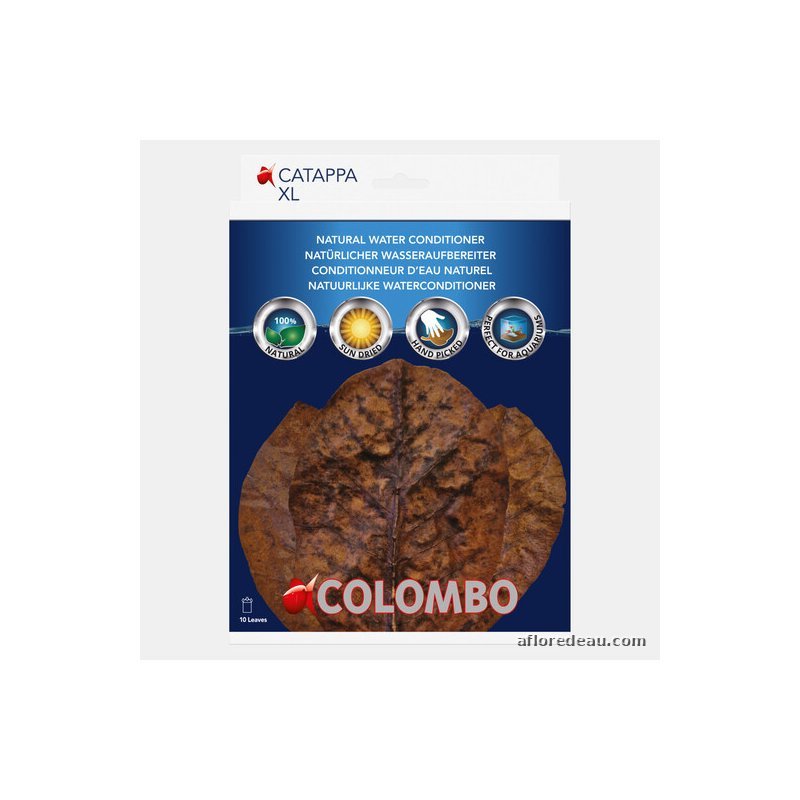
The catappa leaf, from the tropical almond tree, is sold everywhere to “heal”, “colour” and “make fish spawn”. For the medaka, the reality is narrower. It tints the water, acidifies it a little, and its tannins have an antibacterial and antifungal effect measured in the laboratory and on other fish, never on the medaka. It can be useful in one specific case, egg incubation or an indoor fry tank; it brings nothing to an outdoor tub that is doing well, and it drives out the green water that the fry live on. Here is what is known, what is assumed, and the dose that does no harm.
What the catappa leaf is
It is the dried leaf of Terminalia catappa, the tropical almond, a large tree of the coasts of Asia and the Pacific. The Japanese call it モモタマナ, momotamana, and sell it under the name “magic leaf”, マジックリーフ; English speakers say Indian almond leaf. When soaked, the leaf releases tannins, humic and fulvic acids. The water takes on the colour of a light tea, becomes a little more acidic and a little softer, which aquarists call blackwater. It floats at first, soaks up water, sinks, then slowly breaks down, feeding bacteria and infusoria.
What is demonstrated, what is not
The effect on the water is real, and modest in tap water. The acids in the leaf are weak and the carbonate hardness of the water, the KH, absorbs them. In most tap water with some hardness, the pH falls by only a few tenths, as with oak leaves; catappa is simply more concentrated. In rainwater or very soft water, with no carbonate reserve, the drop can be sharp: that is where the leaf becomes dangerous.
The antibacterial effect is measured, but not on the medaka. The most cited study, carried out in Thailand on tilapia, showed that a solution of catappa leaves eliminated the parasite Trichodina from 800 ppm, slowed the growth of the bacterium Aeromonas hydrophila from 0.5 mg per millilitre, and reduced fungal infection of tilapia eggs. Other work in Indonesia and Vietnam points the same way, at varying doses; a Brazilian study found no inhibition at the concentrations tested. These are laboratory trials or therapeutic baths, at concentrations that a leaf in a tank does not reach.
The rest is commercial claim. Brighter colours, stimulated spawning, healing, reduced stress: Tokyo Aqua Garden, which sells the leaf, presents these effects in the conditional and without any measurement. They are described for bettas, apistogrammas and the blackwater fish of the Amazon, not for the medaka.
The medaka is not a blackwater fish
This is the point that sales sheets forget. The medaka lives in the rice fields and ditches of Japan, at a pH of 7.5 to 8 in the wild, and a green-water tub in full sun climbs to 9 or 10 in the afternoon; a Japanese shop puts its comfort zone between 6.5 and 8. It tolerates slightly acidic water, it does not need it. A Japanese aquarium shop even lists the medaka, with the goldfish and African cichlids, among the fish that prefer alkaline water and for which the leaf is hardly suitable. Tokyo Aqua Garden, which also sells it, says so bluntly: “blackwater is not essential for keeping medaka”.
And it has a price for the fry. The same source reminds us: you cannot have blackwater and green water at the same time. Yet medaka fry die far more often from hunger than from disease, and green water is their larder. Putting catappa in an outdoor fry tank means trading their food for a protection they generally do not need.
Where it can be useful
- Egg incubation indoors. Eggs collected and left to hatch in a box or jar quickly go mouldy when a dead egg contaminates the others. Methylene blue is the classic method, described in breeding medaka. Some Japanese breeders replace the blue with water lightly tinted with catappa or alder cones; one reports slightly slower hatching, but fry that came out well. Nothing removes the need to take out the whitened eggs every day: no water, blue or brown, saves a batch where dead eggs are left to rot.
- An indoor fry tank fed by hand. With no green water to preserve, barely tinted water costs nothing, and decomposing leaves feed infusoria. See raising medaka fry.
- A quarantine tank. For medaka that are arriving, lightly tinted water is a gentle precaution, on top of the three-week isolation. It is not a treatment: a sick fish is treated with a real remedy, see medaka diseases.
What dose
Manufacturers give no reliable dose, and the tannin content varies from one leaf to another. The markers from Japanese breeders agree: start low and adjust by eye. For a 10-litre tank, a third to half of a medium leaf is enough; for a one-litre incubation box, a small fragment the size of a fingernail. Aim for the colour of a very light tea, through which you can clearly see the bottom. If the water turns amber, remove the leaf and change a little water.
The leaf is rinsed in clean water before use; it can be cut into pieces or steeped in a tea bag in a little tank water, and the infusion poured in. It works as long as it colours the water, one to three weeks depending on temperature; when the water no longer takes on any tint, replace it, and remove the remains before they form a mush on the bottom.
Precautions
- Never in water with no KH: rainwater, reverse-osmosis water, the very soft water of some granite regions. The pH can collapse. Measure the KH first, see water parameters.
- Not in a tank that is starting up: the antibacterial effect also slows the useful bacteria that convert waste, and too much acidity slows their work.
- Not with activated carbon or zeolite in the filter: they hold back the tannins and the leaf is then pointless.
- Not in a tank whose colours you like to watch: brown water dulls a Youkihi or a Miyuki, and the plants receive less light.
- Not in place of a treatment: catappa prevents a little, it does not cure.
Where to find it
In pet shops and online, as whole leaves or in infusion bags. We offer Colombo catappa leaves, in a large size and a nano size, more practical for small incubation volumes. If you have an alder nearby, its cones do the same job for free: see alder cones in a medaka tank.
The markers to remember
| Effect on the water | tea tint, pH down by a few tenths in tap water |
|---|---|
| Antibacterial effect | measured on tilapia and in the laboratory, never on the medaka |
| Useful for | egg incubation, indoor fry tank, quarantine |
| Pointless or counterproductive | healthy outdoor tub, fry tank in green water |
| Dose | a third to half a leaf per 10 L; a fragment per 1 L; light tea colour |
| Duration | one to three weeks, replace when the water no longer tints |
| Avoid | water with no KH, a tank starting up, activated carbon, zeolite |
Frequently asked questions
Does catappa replace methylene blue for eggs?
It can replace it for those who prefer to avoid a dye, with a less well documented effectiveness. In both cases, what saves a batch of eggs is removing the dead eggs every day.
Will my medaka be more colourful?
Nothing shows this for the medaka. Brown water even makes them look duller, and a fish living on a dark background darkens its black pigments a little, which is not what you want on a Youkihi.
Can I put some outdoors for the winter?
It is not useful. For winter, Japanese breeders use ordinary dead leaves, for the shelter they form on the bottom more than for their tannins: see oak leaves and dead leaves.
What about the shrimp in the tank?
They readily nibble the softened leaf. At a low dose in tap water, no problem; in soft, acidic water, their shells lack calcium.
Sources
- C. Chitmanat et al., “Antiparasitic, antibacterial, and antifungal activities derived from a Terminalia catappa solution against some tilapia (Oreochromis niloticus) pathogens”, Acta Horticulturae 678, 2005, pp. 179-182, ishs.org: Trichodina eliminated from 800 ppm, Aeromonas hydrophila inhibited from 0.5 mg/ml, fungal infection of eggs reduced.
- Tokyo Aqua Garden, “マジックリーフとは” (the catappa leaf), t-aquagarden.com: tannins and humic acids, effects presented without measurement, excess that makes the pH fall, plants deprived of light.
- Tokyo Aqua Garden, “メダカにブラックウォーターっていいの?” (is blackwater good for medaka?), t-aquagarden.com: not essential, blackwater and green water incompatible, hunger threatens fry more than disease, nitrifying bacteria slowed.
- Aqualassic, “ベタだけじゃない。マジックリーフの効果・使い方” (not just for bettas: effects and use of the catappa leaf), aqualassic.com: gradual fall in pH and hardness, not well suited to alkaline-water fish such as the medaka, replace when the water no longer tints.
- 日本神州めだか, “メダカにブラックウォーターの効果とは?” (what blackwater does for medaka), ameblo.jp: a third to half a leaf per 10 L, avoid a tank start-up, activated carbon and zeolite.
- ミジンコおじさん研究所, post of 7 September 2023, x.com: medaka eggs incubated in blackwater instead of methylene blue, slower hatching.
- 雑貨屋サン, “メダカに適したpHは?” (what pH suits the medaka?), zakkaya-sun.shop: habitats at 7.5 to 8, green water at 10, comfort between 6.5 and 8.