
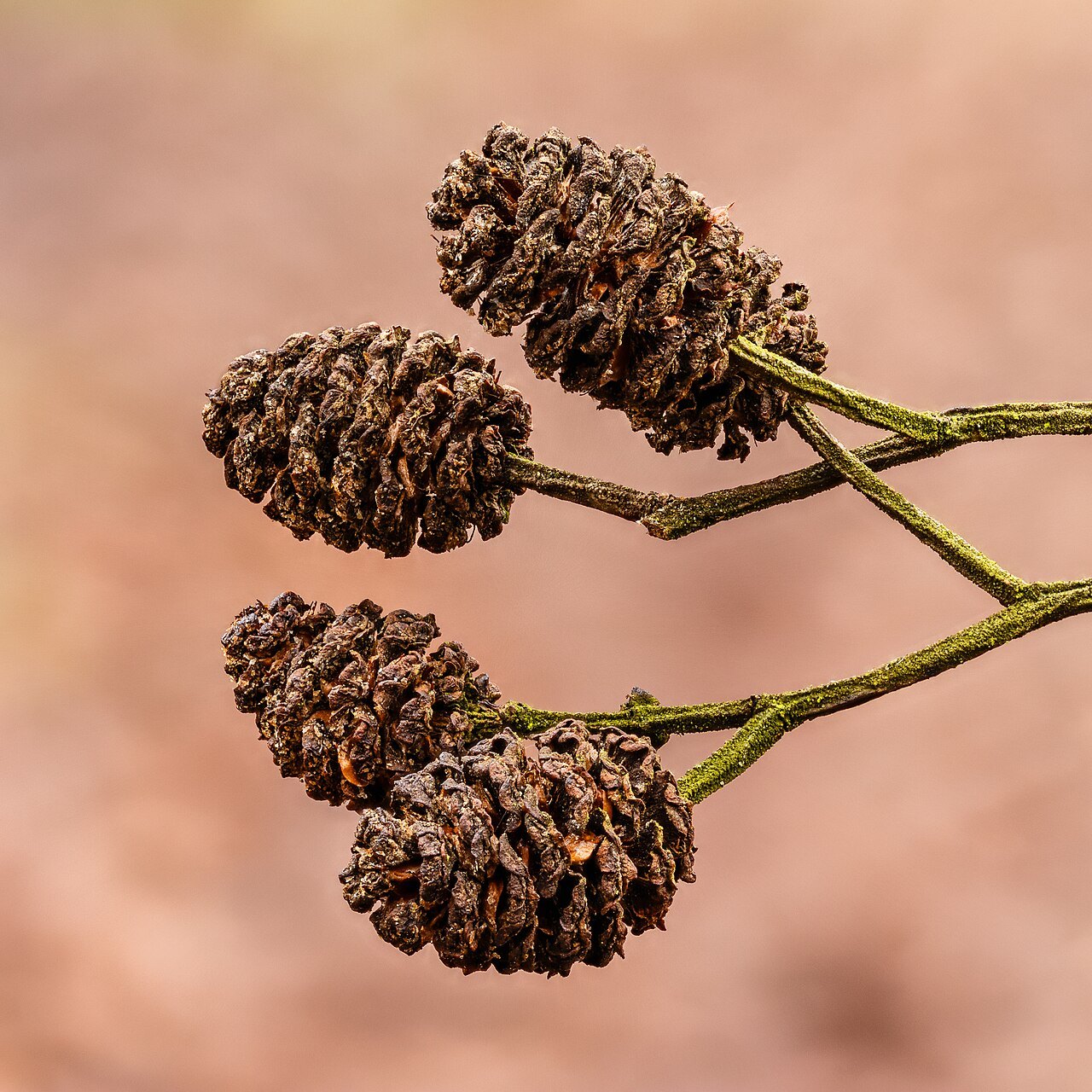
The small brown cones of the alder, which you can gather beside almost every river in Europe, do in a tank the same job as the catappa leaves sold in packets: they tint the water, acidify it slightly and release tannins into it. Japanese medaka breeders use for this the fruits of their local alder, the ヤシャブシ, yashabushi. Here, the common alder gives them free from autumn to the end of winter. As with catappa, the interest for the medaka is limited to a few precise uses, and the dose matters more than anything.
What we are talking about
The common alder, Alnus glutinosa, is the tree of riverbanks: you recognise it by its rounded leaves, notched at the tip, and by its fruits, woody “cones” of 1 to 2 cm that look like tiny pine cones. They are not true conifer cones but clusters of hardened fruits. Green in summer, they turn brown and open in autumn to release their seeds, then stay attached to the twigs all winter, next to the catkins of the following year. It is these brown cones, empty and dry, that are used.
In Japan, breeders use the fruits of the ヤシャブシ, Alnus firma, a mountain alder, sold in packets as an alternative to the catappa leaf. German aquarists, great enthusiasts of shrimp, have long used the cones of our common alder, the Erlenzapfen. It is the same principle.
What they do to the water
When soaked, the cone releases tannins and humic acids. The water takes on an amber tint, more slowly and more lightly than with a catappa leaf, and the pH drops a little. As with all leaves and barks, the carbonate hardness of the tap water, the KH, cushions this drop: in water of KH 5 to 8, we are talking about a few tenths of a unit. In rainwater or very soft water, the drop can be large.
The antibacterial virtues attributed to the cones rest on those of tannins in general. Extracts of common alder leaves and bark do have antibacterial activity in the laboratory, more marked for alcohol extracts than for water extracts; the bark contains a compound, oregonin, whose effect on staphylococcus has been compared to that of an antibiotic. But no study has tested an alder cone in tank water, still less with medaka. What circulates among sellers, disinfection, less fungus, hardier fry, is an extrapolation.
What they are for with medaka
Exactly the same limited uses as catappa, detailed in catappa leaves and the medaka. The medaka naturally lives in neutral to alkaline water, it does not need black water, and black water makes the green water that feeds fry outdoors disappear. What remains:
- incubating eggs indoors, as a gentle alternative to methylene blue: a Japanese breeder incubated his medaka eggs with yashabushi fruits and saw his fry emerge, with slightly slower hatching. Whitened eggs are removed every day whatever happens, see medaka breeding;
- an indoor fry tank, hand-fed, where barely tinted water costs nothing;
- a quarantine tank, as a gentle precaution, never in place of a treatment.
The cone has two advantages over the leaf. It does not break down into mush: it stays whole for weeks and can be removed with one sweep of a net. And it releases more slowly, which leaves time to adjust the tint.
Gathering and preparing
When. From October to March, when the cones are brown, dry and open. The green cones of summer, still full of sap, keep badly and colour too strongly.
Where. On the tree or at its foot, along a clean stream, away from roads, drainage ditches and treated fields. A few handfuls for personal use do the tree no harm; on private land, ask the owner. Do not break off branches: the cones come away by hand.
Preparing. Sort out whole cones with no mould, then rinse and brush them to remove soil and moss. A Japanese breeder advises scalding them for about fifteen minutes to remove the excess material, warning that longer cooking exhausts the effect; scalding also kills insects and eggs that might be hiding in them. Then leave them to dry in the air for a few days: dry, they keep for months in a jar or paper bag.
What dose
The benchmarks vary by a factor of two depending on the source, which mostly says that each cone is different. The Japanese breeder cited speaks of one yashabushi fruit per 10 litres; a German shrimp supplier of one cone per 10 to 20 litres; other sellers of 4 to 6 cones per 100 litres. For a medaka tank, start with one cone per 20 litres, look at the tint after three or four days, and add one if the water stays clear. For a one-litre incubation box, a single small cone is more than enough, and you remove it when the water becomes amber.
A cone acts for two to three weeks. When the water no longer tints after a water change, replace it. If you have a tester, the Japanese rule is simple: remove the cones when the pH has dropped as far as you want, and put them back when it rises.
Precautions
- Never in water with no KH, rainwater or osmosis water: the pH can crash. See water parameters.
- Not in a tank that is starting up, nor with activated carbon or zeolite in the filter, for the same reasons as with catappa.
- No cones gathered just anywhere: an alder beside a road or an agricultural ditch may have received pesticides, and a cone that has lain in polluted water keeps the trace.
- No other fruits at random: pine cones and conifers, horse chestnuts, fresh acorns or green walnuts have no place in a tank. The alder and, at a pinch, the sweetgum, are the only tree fruits in common use.
Alder or catappa?
| Alder cone | Catappa leaf | |
|---|---|---|
| Origin | common alder, by rivers, free | tropical almond tree, imported, sold in packets |
| Tint | slow, light | faster, darker |
| Durability | stays whole, removed in one go | breaks down within a few weeks |
| Starting dose | one cone per 20 L | a third of a leaf per 10 L |
| Duration | two to three weeks | one to three weeks |
| Evidence in the medaka | no study, a few breeder reports | no study, a few breeder reports |
Frequently asked questions
Do alder catkins, the little elongated clusters, work too?
No. Catkins are the male flowers; they fall apart in the water and add nothing. Only the woody brown cones are of use.
Can you put cones in an outdoor tub, for winter?
It does no harm in small amounts, but it adds nothing beyond ordinary dead leaves, which form a shelter on the bottom: see oak leaves and dead leaves.
My cones have turned white in the water. Is that serious?
A light white film of harmless bacteria and fungi often appears in the first days, especially on a cone that was poorly scalded. Remove it, rinse it and put it back; if the film returns, change the cone.
Can I use cones gathered a year ago?
Yes, if they have stayed dry and mould-free. They colour a little less.
Sources
- テキトーブログ, “ブラックウォーター化について” (making black water), ameblo.jp: one yashabushi fruit per 10 L, scalding for about 15 minutes, beyond that the effect disappears, replace when the water no longer acidifies.
- Tokyo Aqua Garden, “メダカにブラックウォーターっていいの?” (is black water good for medaka?), t-aquagarden.com: yashabushi fruits cited as a means of black water, not essential, incompatible with green water.
- ミジンコおじさん研究所, post of 7 September 2023, x.com: medaka eggs incubated with yashabushi fruits in place of methylene blue, slower hatching.
- Garnelio, “Alder cones”, garnelio.de: one cone per 10 to 20 L, shrimp context.
- S. Altınyay et al., “Antimicrobial activity of some Alnus species”, European Review for Medical and Pharmacological Sciences, 2015, europeanreview.org: alder leaf extracts, stronger activity with alcohol than with water.
- University of Reims, study of Alnus glutinosa bark, hal.univ-reims.fr: oregonin, the main compound, active against staphylococcus in the laboratory.
- Illustration photo: empty common alder cones in January, Agnes Monkelbaan, licence CC BY-SA 4.0, Wikimedia Commons.
