
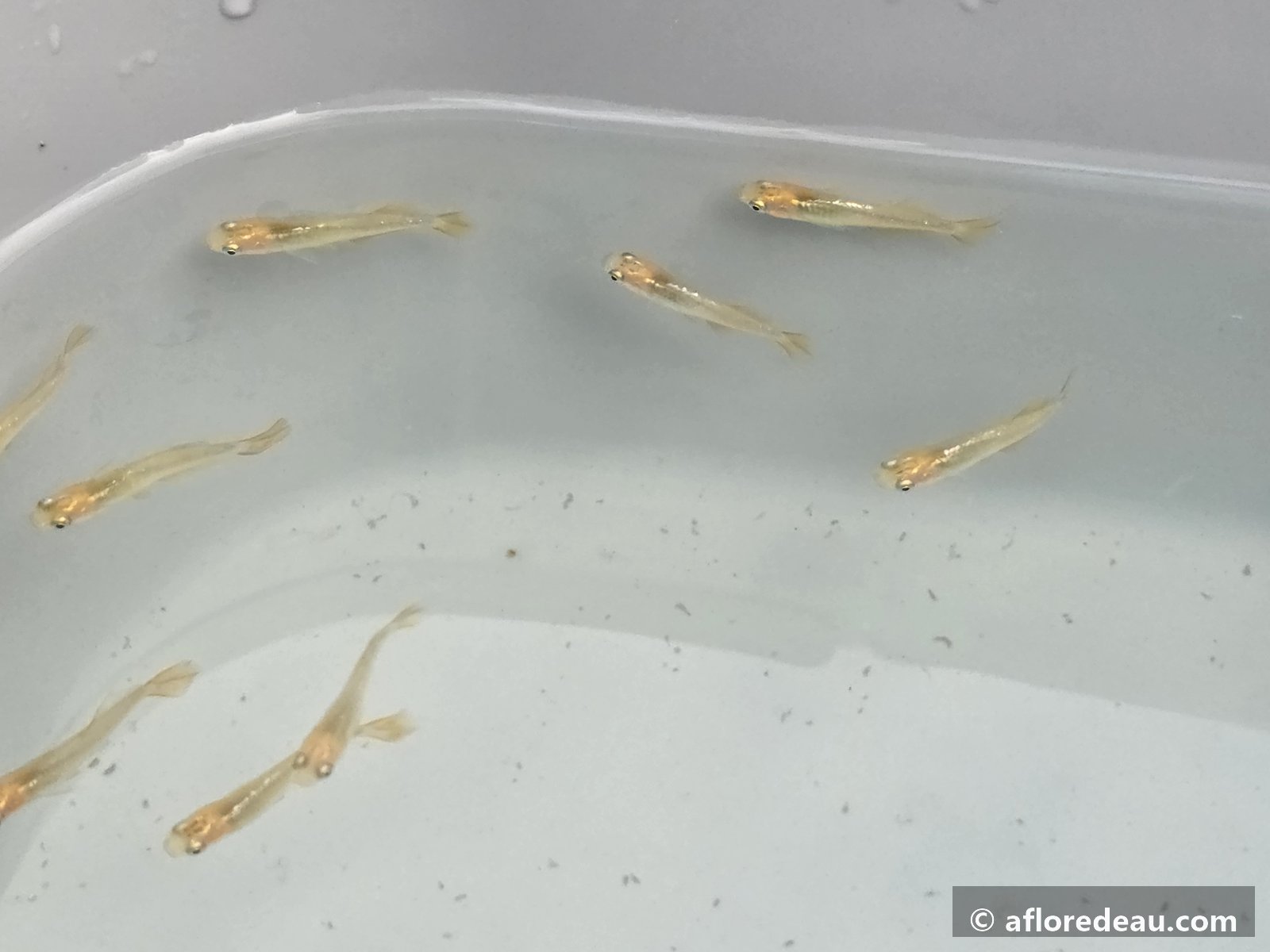
Which medaka traits are recessive, which dominant, which sex-linked, and are any of them lethal? The question deserves a real answer, because the medaka is one of the vertebrates whose genetics is best known anywhere: the first paper on its colours dates from 1921, and a study published in January 2026 sequenced 86 Japanese ornamental varieties to link the names used in the hobby to genes. Here is what is known, trait by trait, what you see when you cross fish, and what remains unknown after a century of work.
Two genes make the four basic colours
In 1921, the Japanese geneticist Tatuo Aida published the analysis of 22 crosses and 17,281 fish. He showed that the four background colours of the medaka are explained by two genes, each with an active and an inactive form, and that the two inactive forms are recessive: they show only if the fish carries two copies.
- The b gene controls melanin, the black pigment. A fish carrying two inactive copies has almost no black left: this is the Himedaka, the orange medaka that has been bred in Japan for centuries. The gene was identified in 2001 (it is called slc45a2); in humans, the same gene is responsible for one form of albinism.
- The r gene controls the orange pigment of the xanthophores. With two inactive copies, the fish is grey-blue: this is the blue medaka, the Ao. This gene remained unnamed for more than a hundred years; a preprint of June 2025 finally identifies it (ttc39bl), which still has to be confirmed by a peer-reviewed publication.
| Genotype | Colour | Hobby name |
|---|---|---|
| B active, R active | brown | wild type, Kuro medaka |
| b inactive, R active | orange | Himedaka, the basis of the Youkihi |
| B active, r inactive | grey-blue | Ao, blue medaka |
| b inactive, r inactive | white | Shiro, white medaka |
These two genes are inherited independently of each other. Cross an orange with a blue: the first-generation young are all brown, because each receives an active copy of b from the blue parent and an active copy of r from the orange parent. The two colours have not disappeared, they are hidden. Cross these browns with each other and the second generation gives back, on average, 9 brown, 3 orange, 3 blue and 1 white out of 16. These proportions have been verified in the laboratory for the brown × orange cross; for orange × blue, they follow from the same rules, and Japanese breeders teach the same result.
The Youkihi is not a third gene. It carries the same inactive b as the Himedaka, and its redder colour comes from selection on many genes of smaller effect: the 2026 study found no locus specific to the Youkihi, only more xanthophores and ten times as much astaxanthin as in a Himedaka. This is why its fixation is almost complete, but the intensity of the red is lost if you stop sorting.
What is sex-linked
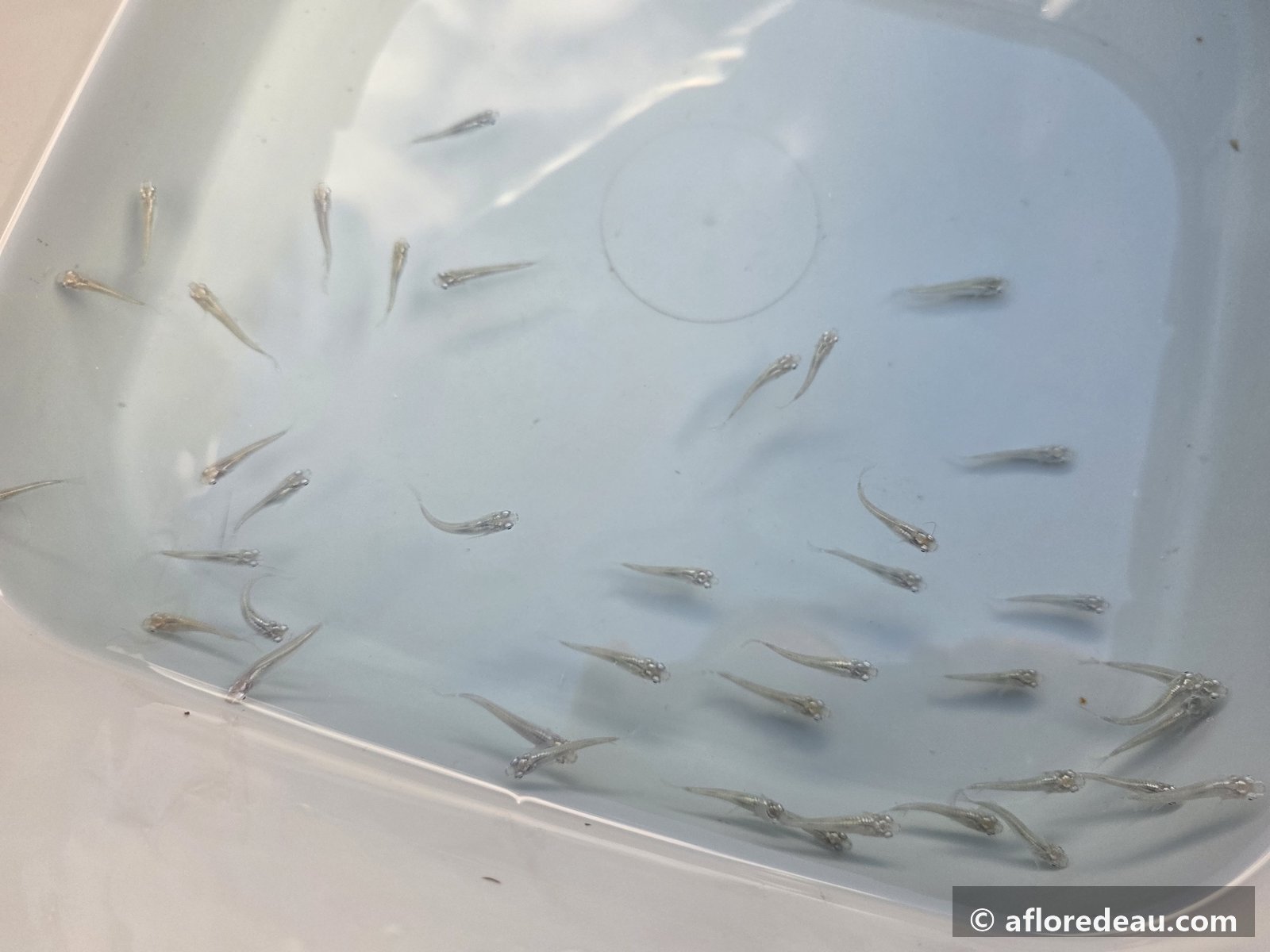
The medaka has sex chromosomes like us, XX for females and XY for males. The gene that decides sex, DMY, was identified in 2002; it was the first gene of this kind found in a vertebrate other than mammals. It sits on chromosome 1.
The r gene for orange colour is on this same chromosome 1. Aida had noticed it as early as 1921: blue or white colour was inherited differently depending on sex. Laboratories drew a famous strain from this, d-rR, in which females are white and males orange, because the active copy of r exists only on the Y. In this strain, colour tells you the sex with more than 99% reliability from the first weeks.
Do not try to reproduce this with your own fish. The white and blue medaka sold commercially carry the inactive form of r on both the X and the Y, so the trait is inherited like any other recessive, with no difference between males and females. To sex your young, you still have the shape of the fins, with its pitfalls in Hikari.
Sex itself is not entirely fixed by the chromosomes. Eggs incubated at 32 °C until hatching gave, depending on the strain, 24 to 50% of genetic females that became fertile males; the reverse does not happen, XY fish remain male. The mechanism runs through cortisol, the stress hormone. For the breeder, this means that a heatwave spawning incubated in a tub in full sun can give a batch skewed towards males. An incubator in the shade, below 30 °C, avoids the question. The threshold, the window and the steps are detailed in temperature and the sex of medaka fry.
Body shapes: Hikari and Daruma
The Hikari type, with a dorsal fin that is a copy of the anal, a diamond-shaped tail and a silvery back, is the mutant that laboratories call Da, for double anal fin. Its cause is known: a large piece of mobile DNA inserted near two development genes, zic1 and zic4. The 2026 study found it in all 35 Hikari-type fish examined, without exception.
You read everywhere that the Hikari is recessive. That is almost true, and the nuance matters for the breeder. Two copies are needed for the complete Hikari body, but a single copy already shows: the carrier has an enlarged dorsal fin, with about ten rays instead of six. Geneticists speak of incomplete dominance. A young fish from a Hikari and a normal one is therefore recognisable by its dorsal fin, and it is the one you keep if you want to get the Hikari back in the next generation. The homozygous Hikari is perfectly viable and fertile.
The Daruma, whose body is shortened by fused vertebrae, has been known to laboratories since 1966 under the name fu, for fused. It is recessive and independent of sex. The exact gene has not been identified: the 2026 study narrows it to a region of chromosome 4 without naming a culprit, and there are probably several different mutations that give the same appearance. Two things are established and useful. First, expression depends on the rearing temperature of the fry: a Japanese source, citing work from 1959, gives 10 to 20% short-bodied fish at 20 °C and nearly 100% at 28 °C in fish of the same genotype. Half-Daruma are the intermediate expression of the same genetic background. Second, some fu lines have females that are often sterile, and Daruma spawn and swim poorly: this is an accepted defect of form, not a lethal trait.
Long fins, transparent scales, Panda, albino
- Long fins. The Japanese hobby describes the Matsui hirenaga as recessive, and no publication contradicts it; science has not yet settled the mode of inheritance, but the 2026 study points to a candidate gene, a potassium channel named kcnq5a, of which the Swallow would be another version. You therefore need to cross long with long to fix the trait, as for a recessive. See the golden Longfin.
- Transparent scales (toumeirin). Neither the gene nor the mode of inheritance is known: the 2026 study found no associated region. Some sellers speak of incomplete dominance, with no published data.
- Panda, transparent iris and peritoneum through lack of iridophores. Recessive. The gene is debated: one of the candidates is that of the laboratories’ “guanineless” mutant, but the genomic signal points elsewhere.
- Albino, with a pink eye. Recessive. There are at least two albinism genes in the medaka; that of the ornamental varieties would be oca2, the same one that lightens the eyes in humans. The idea that albinos see poorly is supported by no study in the medaka; a 2026 preprint even finds the best visual sensitivity in an albino line.
Miyuki, lamé, Orochi, Aurora: selection rather than a single gene
The traits that give recent varieties their value do not follow the simple laws above, and that is precisely why we speak of fixation rate rather than recessive or dominant.
- The dorsal light of the Miyuki depends on several genes: no single locus, and the history confirms it, since the band lengthened from the nape to the snout over eight years of selection starting from a single fish shown at the 2007 contest. Two Miyuki with a full light give young with every length of light, and you keep the best.
- The lamé, those scattered silver scales, has no identified gene either. The number of shiny scales builds up through selection, generation after generation.
- The black of the Orochi is associated with a deletion in a gene (adcy5) but is fully expressed in only 89% of carriers: the rest of the genome modulates the result.
- The Aurora, with visible red gills, is a single-gene recessive (kitlga), with 4% of double carriers that do not show it.
The practical rule follows: for a single-gene recessive trait, crossing two carriers gives a quarter of conforming young, and two conforming fish give 100% conforming. For a polygenic trait, two conforming parents give a majority of conforming young but of varying quality, and it is the sorting that makes the line.
Lethal traits: what is really known
In the official list of medaka mutants kept by the Japanese laboratories, only one trait is noted as lethal in the homozygous state: Va, a laboratory mutant that loses its pigment cells, dominant in the heterozygous state and lethal to the embryo when double. It exists in no ornamental variety.
The 2026 study, which reviewed 86 hobby varieties and 34 traits, reports no lethal trait and none that reduces viability. What it does report is a penetrance often below 100%, and the fact that most ornamental strains are kept inbred. Laboratory lines, inbred for decades, show that inbreeding is not lethal in itself in the medaka, but the vigour of a line is lost without outside input, and it is the breeder who notices it in fertility and clutch size.
Two received ideas circulate that no source supports. “Hikari × Hikari gives deaths”: false, the homozygous Da matures and reproduces like a wild fish. “Daruma × Daruma is lethal”: nothing indicates it; what is documented is the frequent sterility of females in some lines and the difficulty in spawning linked to body shape. If your Daruma produce little, the cause is there, not in a lethal gene.
Summary
| Trait | Inheritance | What you see when crossing with a normal fish |
|---|---|---|
| Orange (Himedaka, Youkihi) | recessive, one gene (b) | F1 brown, F2 a quarter orange |
| Blue (Ao) | recessive, one gene (r), on the sex chromosome | F1 brown, F2 a quarter blue; no male/female difference with commercial strains |
| White | double recessive (b and r) | F1 brown, F2 one sixteenth white |
| Hikari | incomplete dominance (Da) | F1 with enlarged dorsal fin, F2 a quarter complete Hikari |
| Daruma | recessive (fu), expression depends on temperature | F1 normal, F2 a quarter double carriers, of which the visible share depends on heat |
| Long fins | recessive according to Japanese breeders, candidate gene | F1 normal, F2 a quarter long |
| Panda, albino, Aurora | recessive, one gene each | F1 normal, F2 a quarter |
| Miyuki, lamé | polygenic | no fixed proportion; cumulative selection |
| Transparent scales | unknown | note it in your logbook, nobody has published it |
How to use this at the tub
- A recessive trait does not disappear when it stops showing: the browns from your orange × blue cross carry both colours, and will give them back when crossed with each other.
- To fix a recessive, cross conforming with conforming. To recover it after a cross, keep the F1 and wait for the F2: a quarter.
- In Hikari, look at the dorsal fin of the normal-looking young: those with too many rays carry the gene.
- Record the incubation and rearing temperature. It changes the share of visible Daruma, and above 32 °C, the sex of the young.
- Count. In a spawning of 40 young, a single-gene recessive gives about 10; if you have 0 or 30, it is not a simple recessive.
Frequently asked questions
Can you get a Youkihi by crossing any orange with any red?
No. The red of the Youkihi comes from selection on many genes from the orange background. Crossing a Youkihi with a Himedaka gives oranges of varying redness, and it takes generations of sorting to return to red.
My two full-light Miyuki give young that are half lit. Is that a fault?
No, it is the polygenic inheritance of the trait. You keep the brightest as next year’s breeders, and the proportion rises.
I only have males in an August spawning. Why?
If the eggs incubated very hot, in the sun, some of the genetic females may have become males. Incubate in the shade, below 30 °C.
Where can I read further?
On the French-language web, nothing serious exists on this subject; that is the reason for this page. In English, the 2021 tribute to Aida is short and accessible, and the 2026 study by Kon and colleagues is the reference for linking varieties to genes.
Sources
- Fukamachi S., Naruse K., “100 years since the medaka’s international debut: Aida’s legacy”, Genes to Genomes, Genetics Society of America, 2021, genestogenomes.org: Aida’s 22 crosses (1921), the linkage of r to sex.
- Kon T. et al., “Genomic consequences of domestication and the diversification of body coloration and morphology in ornamental medaka strains”, Molecular Biology and Evolution, 2026, doi 10.1093/molbev/msag021; press release of Japan’s National Institute of Genetics, nig.ac.jp: 86 varieties, 34 traits, Hikari = Da, Youkihi with no locus of its own, Miyuki and lamé polygenic, Orochi, Aurora, no lethal trait.
- Fukamachi S., Shimada A., Shima A., “Mutations in the gene encoding B, a novel transporter protein, reduce melanin content in medaka”, Nature Genetics 28, 2001, nature.com: the Himedaka gene.
- Kimura T., Inoue I., “ttc39bl is the gene responsible for the r locus”, bioRxiv preprint, June 2025, biorxiv.org: the blue medaka gene, on the sex chromosome, inactive on X and Y in commercial whites. Not yet peer reviewed.
- Tomita H., “The lists of the mutants and strains of the medaka”, Fish Biology Journal Medaka 4, 1992, nagoya.repo.nii.ac.jp: allelic series of b, sex-linked r, Da “incompletely dominant”, recessive fu and lines with sterile females, Va lethal when homozygous.
- Tomita H., “Studies on the mutant of the medaka, dx-1”, Fish Biology Journal Medaka 2, 1984, nagoya.repo.nii.ac.jp: Aida’s classification, 9:3:3:1 ratios measured.
- Matsuda M. et al., “DMY is a Y-specific DM-domain gene required for male development in the medaka fish”, Nature 417, 2002; Nanda I. et al., PNAS 99, 2002, pmc.ncbi.nlm.nih.gov: the sex gene.
- Sato T. et al., “Induction of female-to-male sex reversal by high temperature treatment in medaka”, Zoological Science 22, 2005; Hayashi Y. et al., Molecular Reproduction and Development 77, 2010, pubmed: 32 °C, 24 to 50% XX males, role of cortisol.
- Kawamura T. et al., Zoological Science 20, 2003, and Yamamoto T., Journal of Experimental Zoology 123, 1953: the d-rR strain, white females and orange males.
- Ohtsuka M. et al., Mechanisms of Development 121, 2004; Moriyama Y. et al., Current Biology 22, 2012: the Da mutant and the zic1/zic4 enhancer; Ohtsuka M. et al., Genome Research 9, 1999, pmc.ncbi.nlm.nih.gov: homozygous Da viable and fertile.
- Takeuchi K., Nature 211, 1966: the fu mutant, fused vertebrae, recessive.
- Fukamachi S. et al., PNAS 2004 (color interfere, somatolactin); Fukamachi S. et al., Genetics 168, 2004 (albino i-3, oca2); Kimura T. et al., PNAS 111, 2014 (leucophore free); Kimura T. et al., G3 7, 2017 (guanineless, pnp4a).
- Mori F., BE-PAL, 2019, bepal.net (Daruma and temperature, after Matsuda 1959) and bepal.net (long fins, Matsui hirenaga and Swallow).
- めだかの館, “メダカと遺伝と色素胞” (the medaka, heredity and pigment cells), medakanoyakata.jp: Japanese popular account, polygenic Miyuki, dorsal fin of Hikari heterozygotes, astaxanthin of the Youkihi.
- medaka.fr: reading a medaka’s name, varieties for beginners and their fixation rate, why fluorescent medaka are something other than selection.