

The best medaka varieties for beginners can be recognised by three things: they cope with European water and climate without special care, they breed without complicated sorting, and their colour shows from above. Of the 23 varieties we describe on this site, ten meet all three conditions. Here is our ranking, and why.
How we ranked the best medaka varieties for beginners
This ranking of the best medaka varieties for beginners rewards neither rarity nor price. It answers a single question: with which one is a beginner most likely to succeed, and to see their fish? To do this, we used four criteria, in this order.
- Hardiness. All varieties tolerate 5 to 30 °C, but some need sheltered overwintering or suffer in the heat. A beginner needs a fish that gets through winter outdoors in a 30-litre tub with a deep zone.
- Breeding. A pair of medaka spawns all summer. What matters is what you get: a variety with a high fixation rate gives young that look like their parents; a patterned variety mostly gives surprises.
- Colour seen from above. You look at a tub or bowl from the top. A colour that shows only in profile, or demands a particular background, disappoints.
- Price and availability in Europe. The simplest varieties are also the cheapest and the easiest to find. We give no prices: they change, and the Japanese prices quoted in our variety pages are only an order of magnitude.
1. The yellow medaka, or Himedaka: the most tolerant of all
The Himedaka (緋メダカ) is the oldest variety of improved medaka. Its fixation is total: two Himedaka give Himedaka, there is nothing to sort for colour. It is also the most tolerant variety we know, and the cheapest. Its colour, an orangey yellow, shows well from above on a dark background. It is on this one that you learn the general method of keeping, the one that then serves for all the others.
Its only fault is looking ordinary next to recent varieties. For a first tub, that is a quality. Full page: the yellow medaka.
2. The Youkihi: vermilion that passes on at 99 %
The Youkihi (楊貴妃) set off the wave of improved medaka in Japan in 2004. Its body is entirely vermilion, and the WEB図鑑 gives it a fixation rate of 99 % or more: a pair of Youkihi gives Youkihi. It is as hardy as the Himedaka, redder, and its colour deepens with age and diet. A dark background is advised.
Between the Himedaka and the Youkihi, the choice depends on the colour you want to see, not on difficulty. Full page: the Youkihi.
3. The orange medaka: the most common
The orange medaka is the most widespread form of improved medaka. Uniform orange body, no sheen or pattern, normal-type silhouette. It is hardy, undemanding, and its colour is already visible on a young fish of a few weeks. It is the one you find most easily in pet shops.
Full page: the orange medaka. The dark orange is also easy to keep, but its shade spreads out in the offspring.
4. The blue medaka: hardy and inexpensive
The blue medaka (青メダカ) is a light grey-blue of normal type. Nothing to report in keeping: it stands the cold, spawns well, costs little. Only one rule to see it: a dark background. On a light background, the blue is lost. It is also the base of most light varieties, which makes it a good first step towards the Miyuki.
Full page: the blue medaka.

5. The Black Dragon: the black that stays black
Black Dragon is a trade name. It denotes an entirely black medaka, from snout to fins, from the Orochi (オロチ) or Black Diamond lines. These lines are hardy, spawn abundantly and pass on their colour well. Their particularity: an Orochi stays black even on a light background, where an ordinary black fades. In our September 2026 batches, in a white tank, they stayed black.
One point to watch: a black body absorbs heat. In summer, shade half of the tub. Full page: the Black Dragon.

6. The yellow Hikari: a shining back, a type that breeds true
The yellow Hikari is a yellow medaka of Hikari (ヒカリ) type: its dorsal fin mirrors its anal fin, its tail forms a diamond, and its back reflects the light. Seen from above, this shining back is what you notice first. According to the WEB図鑑, a Hikari × Hikari cross gives 99 % young of Hikari type: the type is one of the most stable in improved medaka.
What to watch for: spinal deformities, more frequent in this type. Set twisted individuals aside from breeding. Full page: the yellow Hikari.

7. The blue external light, or Miyuki: the best-known variety
The Miyuki (幹之) carries a blue-white reflective band along the line of the back. This is what is called external light, and it is the variety that made the medaka known outside Japan. Hardy and prolific, it passes on its light well, to the point of being the base of more than fifty varieties.
Two traps for a beginner. Fry are born dark and without a band: the light rises with age, from tail to head, and a 1.5 cm young fish that does not shine is not a failure. And the band only shows on a dark background. Full page: the blue external light. The Miyuki Longfin demands more light, warmth and selection: one for later.
8. The white medaka: less fragile than they say
The white medaka, Shiro medaka (白メダカ), has been known in Japan since the Edo period. It has a reputation for being fragile; our sources do not confirm this, and nothing in keeping it distinguishes it from a blue or an orange. On a dark background, it is the most visible variety from above: a white dot can be spotted from afar.
Full page: the white medaka.
9. The Panda: easy to keep, unpredictable to breed
The Panda (パンダ) is not a colour but an eye trait: the iris is ringed with black on a translucent body, which gives it a recognisable gaze, even from above. Keeping is that of a normal-type medaka, without difficulty. The reservation is about breeding: the trait does not appear in all the young, and you have to sort.
We rank it ninth for this reason, not for its upkeep. Full page: the Panda.
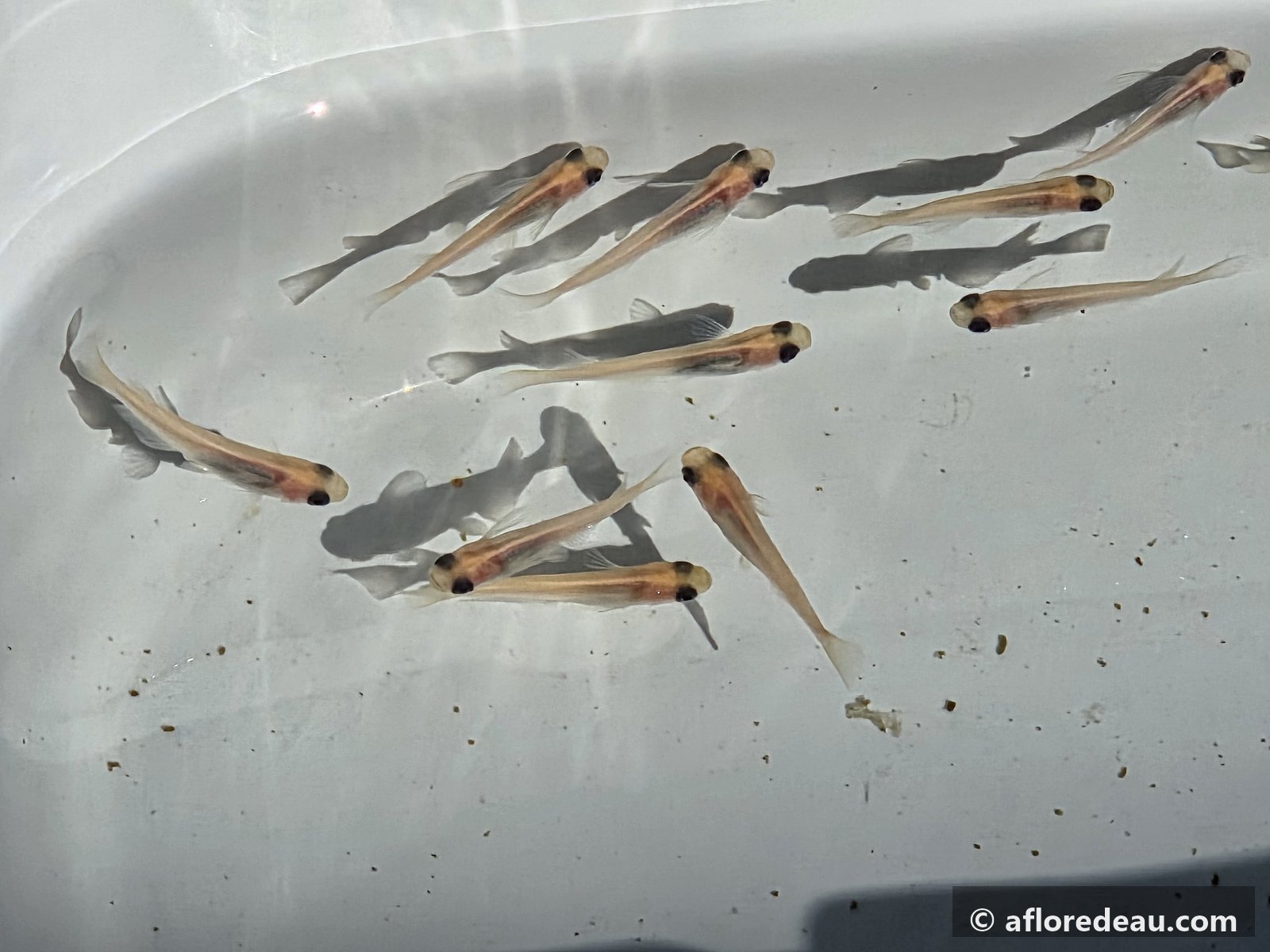
10. The Platinum: light on a white background
Platinum is a trade name. It denotes a medaka with a white or very pale blue body, covered with extended external light, close to the Shiro Miyuki of the WEB図鑑, which describes it as easy to keep and breed. From above, on a dark background, it shines more than a blue Miyuki. No fixation rate is published for this name: you get shining young and others that are less so.
Full page: the Platinum.
The ones we do not recommend for a first tub
They are not bad. They do, however, demand something a beginner does not yet have: the eye for sorting, or the conditions for overwintering.
- The Miyuki Daruma: short body, prone to digestive blockages, cannot winter outdoors, low-yield breeding. A variety for the experienced.
- The Sanshoku lamé and the Kōhaku: easy to keep, but no established fixation rate. Each clutch gives few well-marked individuals, and you have to sort in every generation.
- The Saboten and the Neptune: three traits to maintain together for the first, a timid fish slow to start spawning for the second.
- Patterned varieties sold under English names, Orange Black, White Black, White Orange: no difficulty in keeping, but their offspring scatter into solids and unpredictable bicolours. Disappointing when you expect copies of the parents.
The figures to remember
| Tolerated temperature | 5 to 30 °C, all varieties; breeding from 18 to 20 °C |
|---|---|
| Volume to overwinter outdoors | 30 litres minimum with a deep zone, in Brittany |
| Density | 1 litre per fish at a minimum |
| Fixation, Himedaka and Youkihi | total, or 99 % and more |
| Hikari type | 99 % Hikari young from a Hikari × Hikari cross |
| Recommended background | dark for all these varieties, except a preference for white with lamés and greens |
| Incubation | 250 degree-days: 10 days at 25 °C |
Where to start, in practice
First, a tub of at least 30 litres, planted, without a filter, outdoors, and a single variety in the first season. Then a trio, two females to one male, gives fry the same summer. Set-up: our first-tub guide. To read a variety name before buying: the JMA nomenclature explained. Finally, if you are still hesitating between the best medaka varieties for beginners, take the first on the list: the Himedaka.
Frequently asked questions
Can you mix several varieties in the same tub?
Yes, to keep them. On the other hand, no if you want to breed a variety: medaka interbreed, and the offspring of a mix look like neither parent.
What are the best medaka varieties for beginners in a pond?
The same as in a tub, in the same order: Himedaka, Youkihi, orange, then blue. All of them get through winter outdoors in a sufficient volume, and their colour shows from above, which matters even more in a pond.
Is the Miyuki a good first medaka?
Yes, provided you know that fry are born without light and that you need a dark background. Otherwise you think you have failed, when everything is fine.
Why is the Himedaka first when it is the cheapest?
Because the ranking measures ease, not value. The most tolerant fish, with total fixation, is the one you learn with at no cost.
Sources
- 改良メダカWEB図鑑 (medakazukan.net), Youkihi, Miyuki, Shiro Miyuki, Himedaka entries: fixation rates and difficulty.
- Tokyo Aqua Garden (t-aquagarden.com), keeping articles: temperatures, density, overwintering, Orochi and reaction to background.
- Kamihata (kamihata-online.com), 趣味のメダカ: minimum volume, feeding, light.
- JMA classification manual, 5th edition, September 2025 (jma-medaka.com): nomenclature of traits.
- Our 23 variety pages on medaka.fr, section Species and varieties, and our observations on the September 2026 batches in Lesneven.