
The blue external-light medaka, Ao Miyuki (青幹之), is a blue medaka of normal type that carries the Miyuki’s reflective blue-white band on its back. It is in fact the original Miyuki: the line discovered in 2007 was born on a blue medaka. We call it “Medaka luisant bleu” (shiny blue medaka) in French.
Identity card
| Name | Blue external-light medaka · 青幹之 · Ao Miyuki; this is the normal-type Miyuki (幹之), WEB図鑑 entry no. 0100 |
|---|---|
| Trade name | Medaka luisant Bleu (À Flore d’Eau shop); “Blue Miyuki” or “Miyuki” at importers |
| JMA classification | blue (青) · normal scales · normal eyes · external light (体外光) · no pattern · normal fins · normal type |
| Origin | Miyuki: discovered in 2007 and released in 2008 by Kan Takashi (菅高志), according to the WEB図鑑; blue colour base. Presented at the first Medaka no Yakata contest in 2007. |
| Adult size | 3 to 4 cm |
| Temperature | Tolerates 5 to 30 °C; breeding from 18-20 °C, optimum 20-25 °C |
| Difficulty | Beginner: robust, prolific, a trait that is passed on well |
| Recommended background | Dark: the shiny band is read from above on a black background |
Recognising a blue external-light medaka
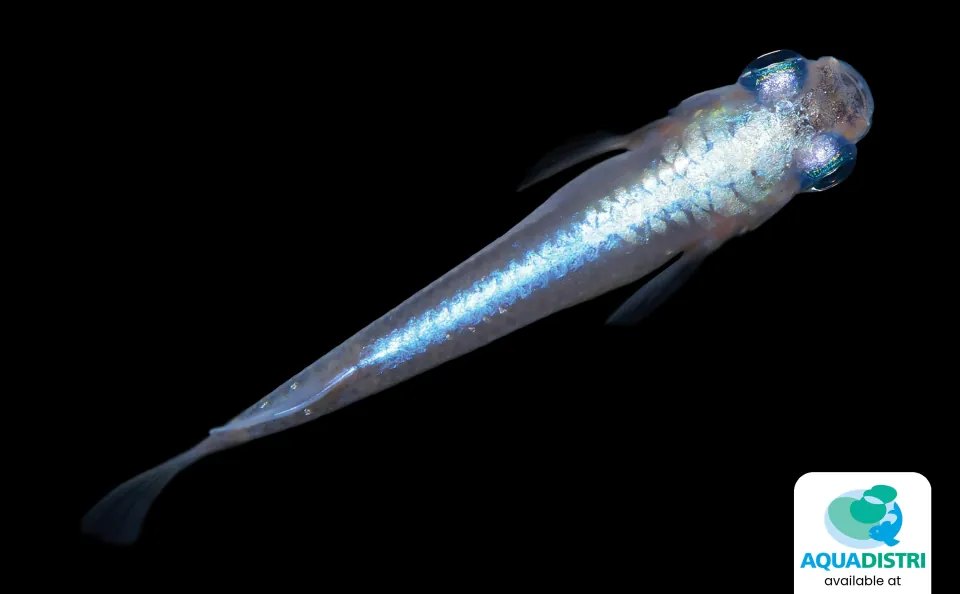
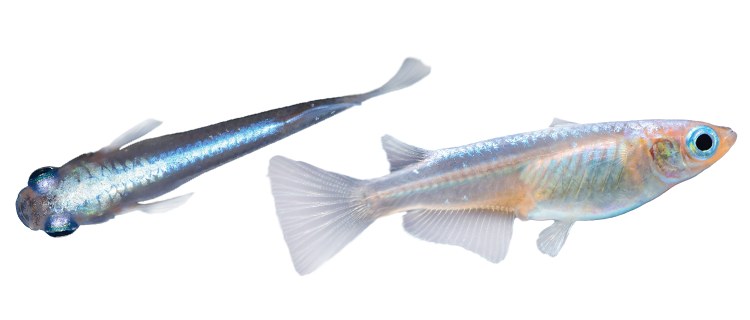
Seen from above, the fish shows a shiny blue-white line that starts at the tail and runs up the back. This is the external light, produced by iridophores, reflective cells. The rest of the body is the grey-blue of the blue medaka: no blue pigment, only black and white without yellow. Seen from the side, the effect is less clear; this fish is viewed from above, in a basin or shallow tank.
The quality of a fish is judged by the length of the band. The WEB図鑑 reports a scale set in 2015: weak light up to a quarter of the body, strong light up to half, super light up to the pectoral fins, super strong light up to the eyes, extreme light up to the mouth. Breeders also speak of the “iron mask”, Tekkamen (鉄仮面), when the light covers the head, and of “full body” when it runs down the flanks. What we call luisant bleu is an ordinary-quality Miyuki, with weak to strong light; fish with an iron mask are sold separately and for much more in Japan.
One point often misleads beginners: the fry are born dark and without a band. The light climbs with age, from tail to head. A 1.5 cm youngster that does not shine is not a failure.
Keeping the blue external-light medaka
Care follows our setup guide: at least 1 litre per fish, pH 7 to 8, plants, settled water. It tolerates 5 to 30 °C and winters outdoors in 30 litres with a deep zone, with no feeding below 10 °C (see overwintering). Feeding according to our guide.
Two tips specific to the variety. First, the background: the shiny band shows on a black background and is lost on a pale one, like the blue colour itself. Second, the water depth: the shallower the tank and the more it is viewed from above, the better the light reads; a water-lily tub suits better than a tall aquarium. A Japanese source ranks it among the varieties recommended for beginners for its robustness and its abundance on the market.
Breeding the blue external-light medaka
Spawning, collection and incubation are those of our breeding page: 250 degree-days, ten days at 25 °C, fry fed from the third day.
The Miyuki is known for passing its light to a good share of its offspring; this is what made it the base of more than fifty varieties, including whites, Daruma and Longfin. Like the Youkihi, it is one of the two founding lines of modern improved medaka. In a batch, the length of the band varies from one fry to another: this is where selection takes place. Do not sort before the light has climbed, so not before 2 cm, and keep as breeders the fish with the longest and widest band, with more females than males in the spawning tank. Crossing two super-lights gives more super-lights; crossing an ordinary shiny one with a blue without light sets the trait back. No quantified fixation rate is published, either in WEB図鑑 entry no. 0100 or at Tokyo Aqua Garden; Japanese breeders describe a high transmission of the trait, with a variable grade and a few blues without light in each spawning.
Similar varieties
- Blue medaka: the same base without the shiny band.
- Miyuki Longfin medaka: external light and elongated fins.
- Miyuki Daruma medaka: external light on a short body.
- Platinum medaka: strong external light on a white base.
- Neptune medaka: blue and lamé, Savanna line 2023.
- Saboten medaka: green, lamé and external light.
Frequently asked questions
Is the luisant bleu a Miyuki?
Yes. The original Miyuki is a blue with external light. “Luisant bleu” is the name we give it in our shop so that the fish is understood at first glance.
My young do not shine. Is that normal?
Yes. The light climbs with age, from tail to head. Wait until 2 cm before judging, and look from above on a black background.
Luisant bleu or Miyuki Longfin?
Same light, same base. The Longfin adds elongated fins, more visible from the side. The normal-type luisant bleu is closer to the original line and swims faster.
Sources
- medaka.fr fact base (section 4 of the SOCLE): TAG, WEB図鑑, Kamihata, afloredeau.com guide.
- 改良メダカWEB図鑑, “幹之(みゆき)メダカとは 改良メダカWEB図鑑No.0100”, https://medakazukan.net/0100_miyukihikari/
- 改良メダカWEB図鑑, “青幹之ヒレ長とは 改良メダカWEB図鑑No.0260”, https://medakazukan.net/0260_aomiyukihirenaga/
- 改良メダカWEB図鑑, “青体色 ~メダカの体色の特徴~” (trait 4/44), https://medakazukan.net/%E9%9D%92%E4%BD%93%E8%89%B2%E3%80%80%EF%BD%9E%E3%83%A1%E3%83%80%E3%82%AB%E3%81%AE%E4%BD%93%E8%89%B2%E3%81%AE%E7%89%B9%E5%BE%B4%EF%BD%9E%E3%80%80%E3%83%A1%E3%83%80%E3%82%AB%E3%81%AE%E4%BD%93%E8%89%B2%E3%81%AE%E7%89%B9%E5%BE%B44/
- AQUALASSIC, “青メダカ 改良メダカ解説”, https://www.aqualassic.com/medaka_ao/
- 東京アクアガーデン, “青いメダカ品種10選”, https://t-aquagarden.com/pro-picks/blue_medaka_variety