

The medaka does well in ordinary tap water, hard water included. It accepts a pH of 6.5 to 8.5 and a temperature of 5 to 30 °C. What kills it is almost never a value in itself, but a sudden change, the chlorine in water that has not been left to stand, and heat above 30 °C. This guide gives the thresholds, explains how to prepare tap water, what to think of rainwater and reverse-osmosis water, and sums everything up in a table.
A rice-field fish
In the wild, the medaka lives in rice fields, ditches and shallow pools, where the water heats up by day, cools at night and becomes concentrated in summer. Its tolerance is therefore wide, far wider than that of tropical aquarium fish. But tolerating a range does not mean tolerating a jump. A medaka moved in one minute from 24 °C to 16 °C is in danger, whereas it would cope with both values if the change took a day. All of water management comes down to this idea.
pH
The accepted range runs from slightly acidic to slightly alkaline, that is 6.5 to 8.5 (WEB図鑑). At À Flore d’Eau, we advise 7 to 8, which matches the tap water of most French municipalities. t-aquagarden gives 6.5 to 7.5 as the comfort zone and warns against water that is too alkaline: beyond that, the mucous membranes suffer and the fertilisation rate of the eggs drops. A pH of 8 to 8.5 is tolerated. A pH of 9 is a problem.
What lowers pH: nitrates that accumulate when water changes become rare, an acidic substrate such as a technical soil or peat, and a heavy fish load. A tank with no water changes slowly acidifies (t-aquagarden). What raises pH: limestone rocks and gravel, crushed oyster shell, and hard water. Japanese breeders put a handful of oyster shell in the filter to hold the pH around neutral (t-aquagarden). Where tap water is limy, this buffer is already in the water.
A stable pH is better than a perfect pH. No acidifying or alkalising products: they make the value swing within a few hours, and it is the swing that hurts. Correct by regular water changes, which bring the tank back towards the value of the tap.
Hardness
Hardness measures dissolved calcium and magnesium. Your water supplier publishes the hardness of the water it delivers, and it depends on the network more than on the country. Broadly, water that has run over limestone and chalk is hard; water from granite country is soft, sometimes acidic. The medaka accepts both. Hard water poses no problem; it even has the advantage of keeping the pH stable. Very soft water is more delicate: with no carbonate reserve, the pH tips quickly towards acid as soon as nitrates accumulate. In that case, a handful of crushed oyster shell or limestone gravel in the tank stabilises the water with no other adjustment. A mineraliser does the same job in a measurable way, where shell is very variable: it dissolves quickly in acidic water and hardly at all in neutral water, so its effect depends on the pH of the tank. Aquatic Science’s Optiminera 1.000, in a small tub, raises and stabilises pH, GH and KH steadily, at 5 g per 1,000 litres, that is half a gram for a 100-litre tank. See our introduction to the Small Pond range.
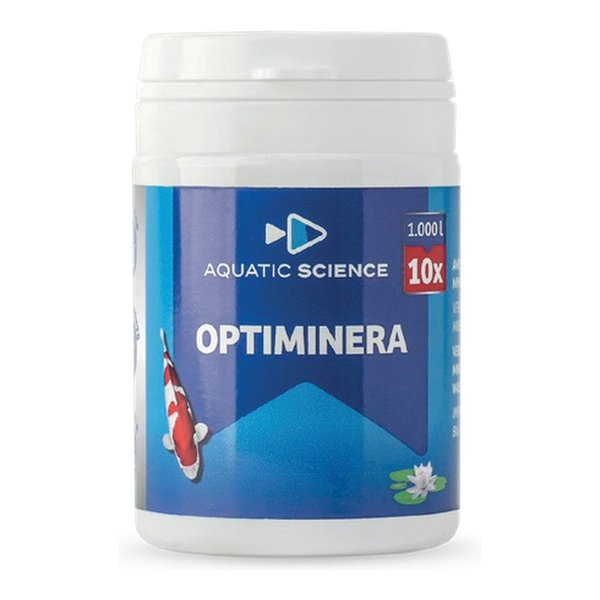
No target value of GH or KH is documented by our sources. The practical marker: ordinary tap water suits the medaka, hard or soft.
Temperature
The tolerance we retain runs from 5 to 30 °C (Kamihata, TAG, WEB図鑑). t-aquagarden widens it to 0 to 38 °C for a healthy adult, specifying that fry, old fish and weakened fish already suffer between 2 and 3 °C, and that a tank frozen to the bottom kills everyone. We keep 30 °C as the advised ceiling: beyond it, the fish is stressed, and 34 °C is a danger zone.
Growth. 20 to 26 °C (t-aquagarden). At 20 °C, the fish becomes active and digests well. Above 26 °C, it eats and excretes more, and the water degrades faster.
Spawning. It starts around 18 to 20 °C and becomes regular from 23 °C, if the day lasts 13 to 14 hours. The stable range of 20 to 25 °C is the one that gives the best eggs. See breeding.
Rest. Below 15 °C, activity drops. Below 10 °C, the fish no longer eats and feeding stops. Between 5 and 10 °C, it overwinters on the bottom. See overwintering.
Swings. A day-night swing of more than 10 °C tires the fish (t-aquagarden). A 20-litre tub in the sun on a balcony can go from 16 °C at dawn to 30 °C in the middle of the afternoon: it is this swing, more than the high value, that wears out medaka. A larger tub, in shade in the afternoon, varies less. During a water change, the difference between the new water and the tank water must not exceed 2 °C (t-aquagarden).
In mild Atlantic climates such as Brittany, an outdoor tub rarely exceeds 28 °C and rarely freezes: the climate is almost ideal. In continental and northern climates, the problem is frost. In Mediterranean climates, it is the heat of July and August: shade half the tub, use a larger volume, top up with fresh water in the morning.
Tap water

Tap water is generally disinfected with chlorine. Chlorine burns the gills and kills the bacteria in the tank. It evaporates by itself: it is enough to leave the water to stand for 24 hours outdoors in a wide container, or 2 to 3 days indoors (WEB図鑑). Gentle stirring or sunshine speeds it up. Chloramine, which is more stable and does not evaporate, is common in North America and exceptional in France; if in doubt, ask your water supplier what treatment it uses, and only a conditioner neutralises it.
A water conditioner does the same job in a minute and also protects the mucous membranes. It is useful when you could not prepare the water in advance, or for an emergency change. Medaka Care is formulated for this use.
Limescale is not a problem for the fish; its white traces come off with white vinegar, in an empty tank. If the water has stagnated overnight in copper or lead pipes, let it run for a few seconds before filling.
Rainwater
Rainwater is soft, has no mineral reserve and is naturally a little acidic: around 5.6 for clean rain according to the Eaufrance sheet on rainwater quality (a French public source), with large differences from one place to another. In a tank with no limestone, it is not enough to stabilise the pH. It complements an outdoor tub well, which receives it anyway. Three precautions. It must come from a clean roof, with no new zinc or copper, and not from the first rains after a long drought, which wash the roof. It must not be the only water in the tank: without minerals, the pH becomes unstable. A mix with tap water that has been left to stand, half and half, is a good compromise in areas with very hard water.
Reverse-osmosis water
Reverse-osmosis water contains almost nothing: no calcium, no carbonates. On its own, it does not suit the medaka. The pH does not hold in it, and the fish loses its salts. It serves only in a mix, to soften very hard water if demanding plants require it. For the medaka alone, it is pointless, like the distilled or demineralised water sold in supermarkets.
What really kills
- The chlorine in water poured straight from the tap.
- An abrupt water change: more than 2 °C of difference, or a pH that jumps by a unit.
- Ammonia and nitrite from a new or overstocked tank. See cycling.
- Water above 30 °C for several days in a row, especially at night in dense green water.
- A tank frozen to the bottom.
- A day-night swing of more than 10 °C repeated all summer in a small tub.
To recognise a fish that is suffering from its water, see the signs of a sick medaka.
The figures to remember
| Tolerated pH | 6.5 to 8.5 (WEB図鑑) |
|---|---|
| Advised pH | 7 to 8 (À Flore d’Eau); 6.5 to 7.5 for t-aquagarden |
| Hardness | Soft to hard water accepted; no documented target value |
| Tolerated temperature | 5 to 30 °C; 0 to 38 °C for a healthy adult according to t-aquagarden |
| Growth | 20 to 26 °C |
| Spawning | Starts at 18 to 20 °C, regular from 23 °C, optimum 20 to 25 °C |
| Stopping feeding | Below 10 °C |
| Stress / danger | Above 30 °C / 34 °C |
| Day-night swing | Less than 10 °C |
| Difference during a water change | 2 °C at most |
| Standing time for tap water | 24 h outdoors, 2 to 3 days indoors, or conditioner |
Frequently asked questions
Do I need a heater?
Not in general. A room at 18 to 24 °C suits all year round. A heater set to 23 °C serves to make the fish spawn in winter, with 13 to 14 hours of light (t-aquagarden). See keeping medaka indoors.
Can I put the medaka straight into tap water?
No. Chlorine harms them. Water left to stand 24 hours outdoors, or a conditioner, at every filling and every change.
How do I measure?
Multi-test strips give pH, GH, KH, nitrite and nitrate in a minute. A floating thermometer in the tank is enough for temperature.
My tank is at 32 °C. What should I do?
Shade it straight away, add fresh water in small amounts in the morning, stir the surface. Never ice cubes directly in the tank, which would create the abrupt change the fish cannot stand.
Sources
- t-aquagarden, column “medaka_ph” (the water that suits medaka: pH, oyster shell, standing water), https://t-aquagarden.com/column/medaka_ph
- t-aquagarden, column “medaka_optimal_temperature” (growth and spawning temperatures, limits, swings), https://t-aquagarden.com/column/medaka_optimal_temperature
- t-aquagarden, column “medaka_waterchange_pace” (pH 6.5 to 7.5, tolerance 2 to 38 °C), https://t-aquagarden.com/column/medaka_waterchange_pace
- medaka.fr fact base (WEB図鑑, Kamihata, TAG, afloredeau.com guide): pH 6.5 to 8.5, temperature 5 to 30 °C, standing water, stop feeding below 10 °C.