
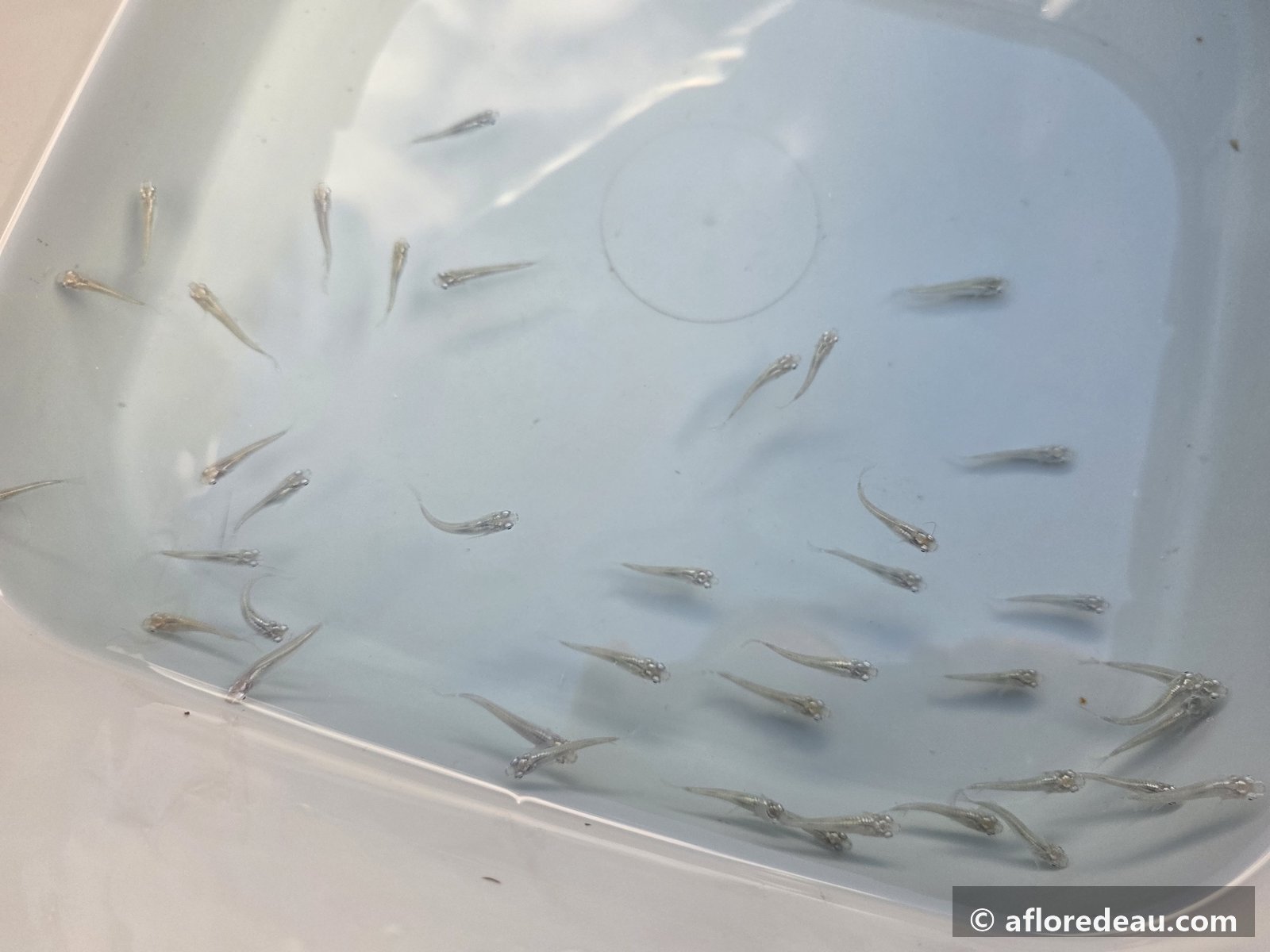
Two questions come up every year at the shop. In autumn: “I have just bought some medaka, can I still put them in my pond?” In spring: “the ones I kept indoors, when can they go back out?” The answer is not a date but a water temperature, a lead time and a size. Japanese breeders have put figures on all three. This page translates them to the European climate and gives, for each situation, what to do.
The rule in three figures
- 18 °C. As long as the pond water is above 18 °C during the day, an adult medaka in good condition can be put in. Below that, its activity drops, it eats less, and it no longer has time to prepare for winter.
- One to two months. This is the time a fish needs, after arriving, to eat its fill, build up reserves and get used to the gradual fall in temperature before the water drops below 10 °C.
- 2 cm, and a rounded belly. A fish under 2 cm, or a thin one, does not overwinter outdoors. Japanese breeders are unanimous, and they add that plumpness matters more than length.
Everything else follows from these three figures, checked against the thermometer, not the calendar. A 30 L tub in Brittany and a bowl on a balcony in a continental climate do not go through the same autumn.
In autumn: how late can you put medaka outdoors
What Japanese breeders say
Tokyo Aqua Garden puts the tipping point at 18 °C: “when the water temperature falls below 18 °C, the medaka’s activity drops markedly”, and from then on any fish under 2 cm or thinner than the others goes indoors. Below 15 °C, the fish hardly eats; below 10 °C, it sinks to the bottom and feeding stops. The manufacturer GEX puts it differently: 15 °C on the way down in autumn is not 15 °C on the way up in spring, “diseases break out more easily” in water that is cooling, because the fish comes from warmth and has not had time to harden. The same site places the final decision, outside or inside, before the end of November, with only two criteria: at least 1.5 cm, and not thin.
The lead time comes from the same Japanese source: a fry born in September “has only one to two months” before the water drops, and winter preparation must be finished by November. A purchased fish is part of the same countdown: it needs those few weeks at a good temperature to eat, grow and go through the drop in temperature gently. The breeder Medaka no Yakata counts “three months minimum” from hatching to an adult able to overwinter.
Translated to the European climate
Pond water holds 18 °C during the day until the end of September in a cold continental or northern climate, until mid-October in a mild Atlantic climate such as Brittany, and until the end of October and sometimes later in a Mediterranean climate. Adding the preparation time, the reasonable window for introducing fish closes:
- Northern, continental and mountain climates: the end of August, early September at the latest.
- Mild Atlantic climates, such as Brittany: mid-September, the end of September for a healthy adult in a well-exposed tub.
- Mediterranean climates: mid-October.
These dates are rough guides. What decides is the thermometer in the water, read in the morning and in mid-afternoon over a few days. If the afternoon stays above 18 °C and the morning does not fall below 12 °C, you can still introduce an adult. If the water is already at 15 °C during the day, it is too late for a newcomer, even in Brittany.
The fish bought late
A medaka bought in October or November does not go into the pond. It spends the winter indoors, and does so well. There are two ways. Without heating, in a cool room at 12 to 15 °C, a lit garage, an unheated conservatory: the fish lives in slow motion, eats a little on mild days, does not grow, and goes out in spring. With a heater set between 20 and 25 °C: it keeps eating and growing all winter, which is the right solution for a young fish under 2 cm, which will be an adult by March. In both cases, you join it to the pond in spring, under the conditions described below. The details of indoor overwintering, volume and feeding are in overwintering medaka outdoors in Europe.
A fish that dies in January in a pond is almost always a fish that went in too late or too small. A late-season purchase is not a mistake, provided you reserve a tub indoors for it until spring.
Preparing those already outdoors
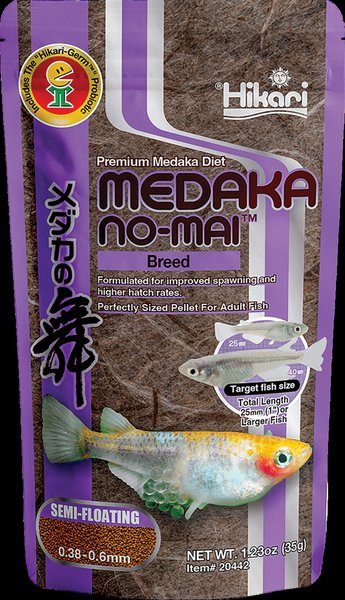
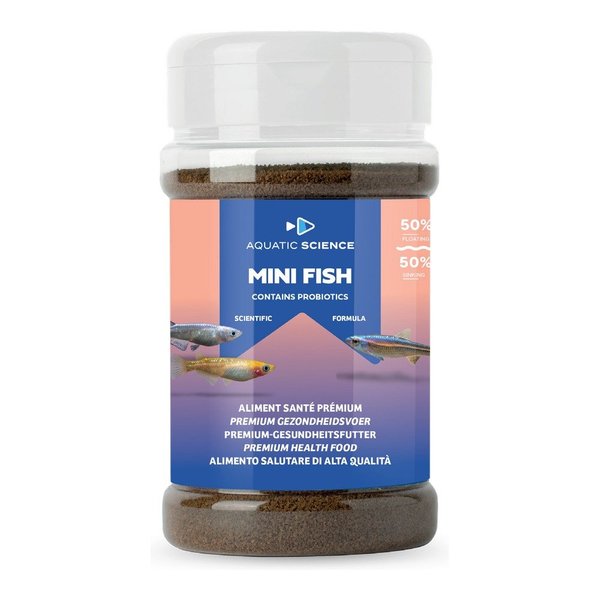
For fish settled since the summer, autumn is for building fat. Tropica, the sister site of Tokyo Aqua Garden, sums it up: “a thin medaka has a strong chance of not getting through the winter”. As long as the water is above 15 °C, feed richly, in several small meals, at least two a day, and multiply the meals rather than the dose. Feed in the warm hours, between 10 am and 3 pm, because in autumn the water can vary by 5 to 10 °C between night and afternoon. Daphnia, which stay active down to about 10 °C, and green water complement the pellets, Hikari Medaka Breed or Aquatic Science Mini Fish, for example. Cut back to one meal a day when the water falls below 15 °C, and stop when it falls below 10 °C and the fish stay on the bottom. These are the same thresholds as in medaka through the seasons.
In spring: when can you put medaka out
What Japanese breeders say
Waking up happens around 10 °C; the real season begins when the water passes 15 °C; you feed from 15 °C, once a day, until 20 °C is stable. But putting out a fish that has been kept warm is quite another matter from waking a fish that has slept outdoors. Tokyo Aqua Garden gives the benchmark: “when the daytime water temperature settles around 18 °C, around April, after carefully equalising the temperatures”. And the method for a heated tub: “switch off the heating and wait a few days, until the difference with the outside is 5 °C at most”. Medaka no Yakata proceeds in the same way, lowering the heating in steps and waiting until the pond passes 15 °C during the day. GEX, more cautious still, advises “early May, during a run of warm days”.
The reason for this caution comes down to one Japanese word, 寒の戻り, the return of the cold. Tokyo Aqua Garden describes early springs when “you think the warmth has arrived and the temperature immediately falls back to midwinter levels”; the awakened fish go back to sleep, and the insulation material must stay to hand “until around April”. The same source reminds us that a swing of more than 10 °C in a day exhausts the fish, and that it tolerates water that is falling far less well than water that is rising. March nights drop below 10 °C while the afternoon flirts with 18 °C: that is precisely the amplitude that kills a fish taken out of a room at 22 °C.
Translated to the European climate
The benchmark “18 °C stable during the day” arrives in Europe:
- Mediterranean climates: late March, early April.
- Mild Atlantic climates, such as Brittany: late April, early May. A late cold snap in mid-May is still a good thing to guard against: gardeners do not put their tomatoes out before it has passed, and neither should you a heated medaka.
- Northern, continental and mountain climates: mid-May, late May.
For a fish that overwintered outdoors, there is nothing to put out: it wakes by itself, and you resume feeding at 15 °C as described in the overwintering page. For a fish that overwintered indoors without heating, at 12 to 15 °C, the difference with the pond is small from April: you can put it out as soon as the pond passes 15 °C during the day and 10 °C in the morning, equalising the temperatures. For a heated fish, wait for a stable 18 °C, and apply the gradual drop described below.
Buying for the pond in spring
A medaka bought in March comes from a sales tank at 18 or 20 °C. Putting it in a pond at 12 °C is the same shock as coming out of a heated tub. A March purchase therefore goes into an indoor tub, and joins the pond only when the pond holds 18 °C during the day. Tokyo Aqua Garden also recommends spring, “when activity is high”, for starting to keep medaka, and feeding sparingly “until the temperature settles, around May”. May is, in Europe, the best time to stock a pond: the water is established, the cold snaps are over, and the fish have the whole season to settle in and spawn.
The transfer itself: equalise, then mix
Whichever way it goes, indoors to outdoors or bag to pond, the rule is the same: you do not change a fish’s temperature, you change the temperature around it.
- Reduce the difference before the day. For a heated tub, lower the setting by 1 °C a day, then switch off the heating and wait a few days, until the tub water and the pond water are within 5 °C of each other. Tokyo Aqua Garden cites the opposite example, from 15 °C outdoors to 23 °C indoors at a stroke, as a shock that can kill a weakened fish.
- Choose the moment. A mild early afternoon, without wind, after several stable days, never a cool morning nor the eve of a forecast frost.
- Equalise. The fish goes into a bag or a bucket with its original water, which floats in the pond for twenty to thirty minutes, an hour if the difference approaches 5 °C. GEX, for the spring move out after winter, goes up to two hours, adding 50 mL of pond water every thirty minutes.
- Mix. Replace a glass of the bag’s water with a glass of pond water, three times, five to ten minutes apart, then release the fish without pouring in the bag’s water.
- Do not feed on the first day, and stay on small rations, once a day in the middle of the day, until the water has passed 20 °C.
For a simple top-up of the pond, the permitted difference is 2 °C: fresh water colder by more than 2 °C is enough to weaken the fish.
Varieties that do not go out like the others
Daruma, with their short bodies, digest poorly in cold water and turn belly up when the temperature drops: Japanese breeders keep them warm, Tokyo Aqua Garden considers heating “indispensable” and advises 28 °C. A Daruma goes out later than the others, when the water holds 20 °C, and comes in sooner, as soon as nights drop below 15 °C; see the Miyuki Daruma page. Albinos, with red eyes, tolerate full sun poorly rather than cold: a shaded pond. For long fins and transparent scales, no Japanese source describes any particular winter fragility; we treat them like the others, with the rule of 2 cm and a rounded belly.
At Lesneven, in northern Finistère, we apply a simple calendar: medaka kept indoors go out in May and come in in October; Daruma go out only from June to September. These are Breton months, to be shifted one way or the other according to your climate, but the thermometer remains the judge.
The figures to remember
| Autumn introduction | water above 18 °C during the day, and one to two months before the water falls below 10 °C |
|---|---|
| Size to overwinter outdoors | 2 cm, rounded fish; 1.5 cm at the very least in a mild region |
| Bought too late | indoors until spring, 12-15 °C without heating or 20-25 °C with |
| Spring move out, heated fish | water at a stable 18 °C during the day, difference of 5 °C at most after dropping 1 °C a day |
| Spring move out, fish overwintered cool | pond at 15 °C during the day and 10 °C in the morning |
| Stocking a new pond | May, after the cold snaps |
| Equalising | 20 to 30 minutes in a floating bag, up to 1 or 2 hours if the difference approaches 5 °C |
| Topping up water | difference of 2 °C at most |
| Daruma | outdoors only above 20 °C |
| Here, at Lesneven | outdoors from May to October; Daruma from June to September |
Frequently asked questions
I bought medaka at the end of October in Brittany, and the pond water is at 14 °C. Do I put them outside?
No. At 14 °C, they will hardly eat and will not have time to build up reserves. Keep them in a tub indoors, cool or heated, and put them out at the end of April.
My outdoor fish are already swimming in March. Can I add the ones from the aquarium?
Not yet. Those outside are hardened by winter; those from the aquarium come from water at 20 °C. Wait until the pond holds 18 °C in the afternoon for several days in a row, and lower the aquarium by 1 °C a day first.
What is the best month to buy medaka for a pond?
May. The water is established, the cold snaps are over, and the fish have the whole season to settle in. September is also fine for adults, provided it is early in the month.
Can a 1 cm fry stay outdoors in October?
No, except in a Mediterranean climate and with a deep tub. Everywhere else, it spends the winter indoors, preferably heated, to reach 2 cm before spring.
Sources
- Tokyo Aqua Garden, “秋に生まれたメダカを育てる方法” (raising medaka born in autumn), 2023, updated on 11 September 2026, t-aquagarden.com: 18 °C threshold, 2 cm, one to two months, move out at a stable 18 °C around April, 5 °C difference, 1 °C a day.
- Tokyo Aqua Garden, “冬眠から起きた魚のケア方法” (caring for a fish emerging from hibernation), 2024, t-aquagarden.com: waking at 10 °C, cold snaps until April.
- Tokyo Aqua Garden, “春のメダカ管理術とコツ7選” (seven spring tips), 2025, t-aquagarden.com: feeding from 15 °C, heating kept until April.
- Tokyo Aqua Garden, “メダカに最適な水温とは” (the ideal temperature), 2022, t-aquagarden.com: 2 °C difference when topping up, 10 °C daily swing at most, fragility to falling temperatures.
- Tokyo Aqua Garden, “メダカの冬対策と冬眠” (winter and hibernation), t-aquagarden.com and “ダルマメダカ”, t-aquagarden.com: heating indispensable for Daruma.
- Tokyo Aqua Garden, “メダカをもらったら” (when you are given medaka), 2024, t-aquagarden.com: equalising for 20 minutes, three glasses of water.
- Tropica, “秋はメダカが大きく育つ!” (in autumn, medaka grow big), tropica.jp: a thin fish does not overwinter, at least two meals a day.
- GEX, outdoor breeding calendar, gex-fp.co.jp: 15 °C falling riskier than 15 °C rising, two-hour equalising in spring; questions and answers, gex-fp.co.jp: decision before the end of November, 1.5 cm and not thin; move outdoors “early May”, gex-fp.co.jp.
- Medaka no Yakata, heated and outdoor breeding calendars, medakanoyakata.jp: heating lowered in steps, move out when the pond passes 15 °C during the day, three months from hatching to adult.
- Hime-medaka, “稚魚の冬越し” (overwintering fry), hime-medaka.com; Medakaya En, “越冬”, 2025, medakayaen-ec.com: 1.5 to 2 cm, plumpness more than length, Daruma that turn over.
- medaka.fr fact base: thresholds of 5, 10, 15, 18 and 23 °C, 30 L minimum and a deep zone for overwintering in Brittany (afloredeau.com guide).