
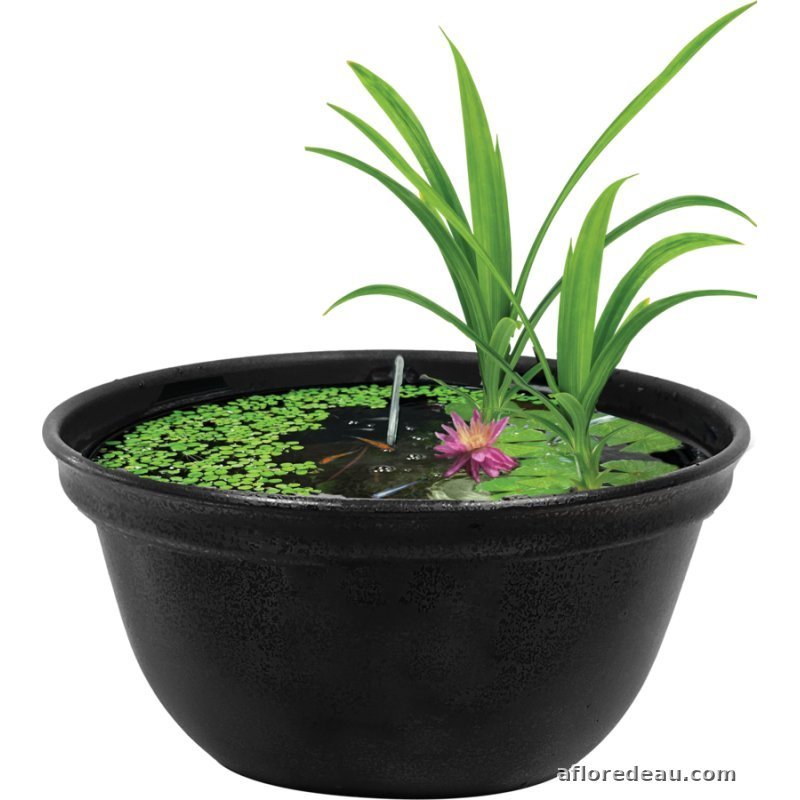
A tub of medaka set outdoors, planted, with no filter, looks very much like a pond. The frogs, toads and newts of the garden are not fooled: from the very first spring, one of them moves in or spawns there. Should you worry for the fish, should you worry for the amphibians, and what are you allowed to do? Here is what Japanese breeders say, who live with the same thing in their tubs, what studies show on the species of France, and what the French protection order of 2021 says, which is stricter than people think.
Who really eats whom
Let us start by dismantling the image of the frog that empties a tub. Of the species that can turn up in a Breton garden, only one has documented predation on small fish: the green frog, the one that sits at the water’s edge all summer. Naturalist accounts describe it as very voracious, eating insects, worms, tadpoles, including those of its own species, “and sometimes small fish too”. Sometimes: a large female settled at the edge of a narrow tub may take a medaka that comes up to gulp at the surface, but no study puts a figure on it, and Japanese breeders who watch their equivalent, the Tonosama frog, mostly report tubs where a big frog spent the summer without the population falling. At our shop in Lesneven, we have never yet seen a frog attack a medaka.
The other adults do not eat medaka. The common frog hunts beetles, flies and molluscs on land, and goes into the water only for a few weeks in winter, when the medaka are asleep on the bottom. The tree frog hunts insects in bushes. The spiny toad eats weevils and ants, and eats almost nothing during its breeding. The midwife toad, snails and worms. The Japanese make the same observation with their tree frog, by far the most frequent visitor to their tubs: it comes to bathe and catch mosquitoes, and does not go for the fish.
Newts are another case. A palmate or alpine newt eats amphibian eggs and larvae, and studies of stomach contents show a behaviour of hunting motionless prey. That they take medaka eggs or fry is plausible and undocumented, but it is the most serious risk to a spawning in an outdoor tub. The Japanese red-bellied newt has this reputation in the tubs over there.
And the other way round? The medaka eats its own eggs and fry, as every breeder knows. On frog eggs and tadpoles, there is no study, but a Swiss experiment on a fish of the same size, the sunbleak (Leucaspius delineatus), 4 to 6 cm, reputed harmless going by its diet, saw 100% of common frog eggs and small tadpoles eaten in the laboratory. You must assume that a tub of medaka eats the spawn of brown frogs, green frogs and tree frogs, at least when freshly hatched. Not that of the toad: its tadpoles are toxic and fish leave them alone. This is, moreover, the general rule of ponds: amphibians are fewer where there are fish, and palmate newts leave the water and spawn less when goldfish are put in.
Tadpoles, a water problem more than a teeth problem
Japanese breeding sites repeat that tadpoles eat eggs and weak fry. No study shows it, and the stomach contents of common frog and toad tadpoles in Europe are made of sediment, plant debris and diatoms. The only published direct observation shows tadpoles clustered on a frog spawn, not on fish eggs. The conclusion is that tadpoles may clean up a dead egg or a dying fry, but they are not the ones emptying a healthy spawning.
The real effect of tadpoles lies elsewhere, and Japanese breeders are unanimous: they eat the same algae and the same green water as the fry, they foul a small volume quickly, and a toad’s string of spawn gives hundreds of tadpoles in 100 litres. Ammonia rises, oxygen falls on warm nights, and a dead tadpole on the bottom makes the tub go off. A dead adult frog on the bottom is worse. In a fry tub, that is reason enough to keep amphibians out.
What the law says
This section describes French law only. Other countries have their own rules, which we do not cover here: check them locally.
All amphibians in France are protected by the order of 8 January 2021, and the protection does not stop at the adult animal: the text defines the “specimen” as any egg or any individual, living or dead. Tadpoles and spawn are therefore protected like adults. The order sorts species into three levels.
- Full protection (article 2): it is forbidden to destroy or remove eggs, to capture, transport or keep animals, and to degrade breeding sites. In Brittany: midwife toad, European tree frog, agile frog, Lessona’s pool frog, marbled newt, great crested newt, natterjack toad, parsley frog.
- Individuals and eggs protected (article 3), without protection of habitats: spiny toad, marsh frog, palmate newt, alpine newt, smooth newt, fire salamander.
- Partial protection (article 4): only mutilation and commercial use are forbidden. These are the edible frog and the common frog.
The consequence for a garden tub is clear. A spawn of toad, tree frog, agile frog or newt in your tub can be neither destroyed, nor removed, nor moved to the pond next door: removing eggs and transporting them are two separate prohibitions, and a prefectoral exemption is rarely granted to a private individual. Letting it finish its cycle is the only safe option. For the common frog and the edible frog, the order does not forbid removing a spawn, but nothing requires you to do so either. On the other hand, preventing spawning before it happens, by covering the tub, is not destruction: it is the legal lever, and it comes down to the calendar.
We wrote elsewhere on this site, and we correct it here: “moving the frogs to a pond without fish” is not advice that can be given in France for most species. It is nevertheless the common practice of Japanese breeders, who release the frog into the neighbouring rice paddy; their law is not ours.
The calendar works in your favour
In Brittany, amphibian breeding runs from December to June, that of medaka from May to September, from 18 °C. The two overlap only in early summer. The dates below are for Brittany; they shift with the climate where you live.
| Species | Spawning in Brittany | Leaves the water | Overlap with medaka |
|---|---|---|---|
| Common frog | late December to March | late May | none: the medaka are torpid and do not spawn |
| Spiny toad | late February to mid-May, peak in March | June | slight; toxic tadpoles, untouched by fish |
| Agile frog | February, sometimes January | May-June | none |
| Palmate and alpine newts | March to June | summer, sometimes larvae overwinter | yes in May-June, on the first medaka spawnings |
| European tree frog | April-May | July-August | yes |
| Green frogs | May to early July | August-September, sometimes after winter | the whole season |
| Midwife toad | March to August, eggs carried by the male | overwintering tadpoles, up to 9 cm | the whole season, very large tadpoles |
In practice: a medaka tub left open all winter receives common frog and toad spawn without harm to the fish, but it becomes a tadpole nursery until June, just when you would want to collect eggs from it. A tub covered before Christmas receives nothing. A fry tub set up in May and covered from the moment it is filled receives neither newts nor tree frogs.
Two waters rather than one
The solution that suits everyone is the one also recommended by the “Frog refuge” charter of Eau et Rivières de Bretagne: a water point for amphibians, with no fish at all, and tubs for the medaka, covered. A medaka tub is a poor spawning place for a frog, since the fish eat its eggs; a frog pond is a poor breeding tub, since you collect no fry from it. The two side by side complement each other: the pond attracts the frogs that would otherwise come to the tub.
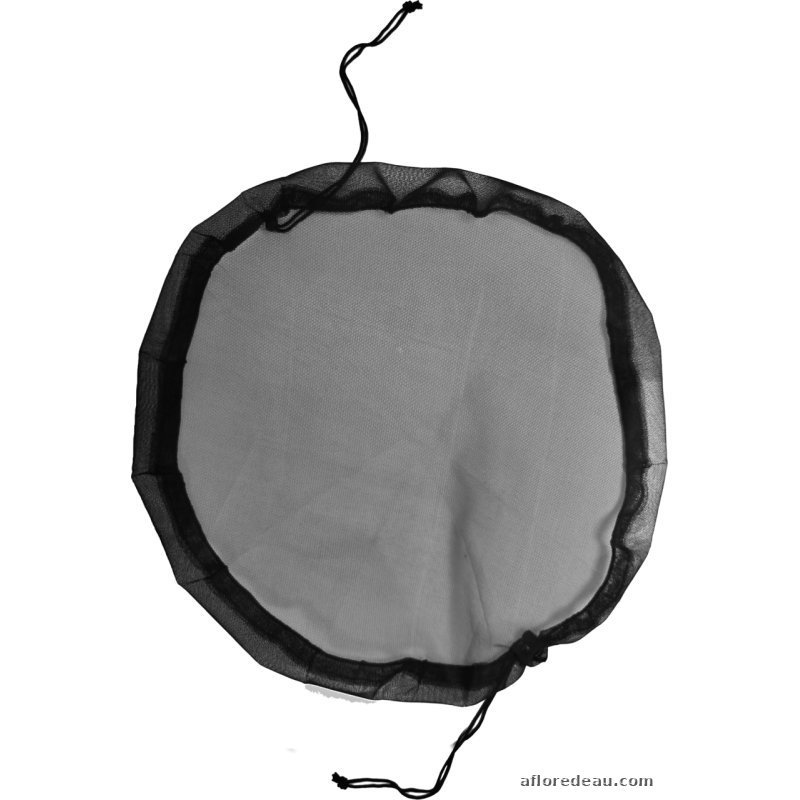
- The net. For the Medaka Bowl 420, we sell the Medaka Cover Net, a fine-mesh cover net fitted to the tub: it rests on the rim, above the water level, comes off in one move for feeding, and stops frogs, newts, cats and birds as well as dead leaves, while letting light and air through. For another tub, the same net as used against dragonflies will do: 1 cm mesh, stretched 5 to 15 cm above the water without touching the surface, weighted at the edges. Put on before the spawning season, it settles the legal question before it arises.
- The water level. A tub filled to the brim exposes the medaka to frogs sitting on the rim; a level 10 cm below the edge, with smooth walls, keeps them out of reach and limits the fish’s jumps, which trigger the attack.
- The fry tub, always covered, set apart. This is where newts and the tadpole load do the most damage.
- The pond, however small, with 1 m depth over part of it for overwintering, gently sloping banks, marginal plants, and not a single fish, not even “for the mosquitoes”: tadpoles and dragonfly larvae take care of that. The plants for a small pond suit it too.
If a frog is already there
An adult tree frog, toad or common frog that comes to the tub does nothing to the fish: leave it. A green frog settled for good perhaps takes a medaka now and then; do not capture it, cover the tub and lower the level, and it will go and sit elsewhere. A spawn already laid is left to hatch, except for the two article 4 species; space out the fish’s meals, change a little water each week during the tadpole period, and remove dead tadpoles. Tadpoles that remain at the end of summer, midwife toads and late green frogs, overwinter in the water: take this into account before emptying a tub in autumn.
Two things never to do, for a reason that is not only legal. Moving a spawn, a tadpole, a frog, water or plants from one water point to another carries amphibian diseases: chytridiomycosis, which has caused mass mortalities in France and Spain, the salamander fungus, and ranaviruses, which pass from fish to amphibians through the water. And releasing into the wild an animal bred at home, medaka included, is forbidden for the same reasons: see releasing a medaka into the wild. Nets and tubs that pass from one water to another are disinfected, or dried completely between uses.
The figures to remember
- Only one frog in France sometimes eats small fish: the green frog. The others do not.
- A fish of 4 to 6 cm ate 100% of the eggs and small tadpoles of the common frog in the laboratory: a medaka tub is not a refuge for frogs.
- Amphibian spawning in Brittany: December to June. Medaka spawning: May to September.
- 1 cm mesh, net 5-15 cm above the water, put on before Christmas.
- For the species in articles 2 and 3 of the French order, removing or transporting a spawn is forbidden; preventing spawning by covering is not.
Frequently asked questions
A frog has moved into my tub. Will it eat my medaka?
If it is a green frog, perhaps one now and then; if it is a tree frog, a toad or a common frog, no. Cover the tub and lower the level, and it will change position.
Tadpoles have appeared with my fry. What should I do?
Leave them: for most species in France that is the law, and they do not eat live fry. Feed less, change 10% of the water each week, remove dead tadpoles, and next summer cover the fry tub as soon as it is filled.
Can I put a few medaka in my pond “for the mosquitoes”?
No. You will lose the frog and newt spawn, and the medaka will do less well than the dragonfly larvae and newts already living there. See medaka and mosquitoes.
Can I take a spawn from my tub to raise it separately?
For every species except the common frog and the edible frog, that is keeping protected specimens, forbidden in France without an exemption. Leave it where it is.
Sources
- Order of 8 January 2021 setting the list of amphibians and reptiles of mainland France protected throughout the national territory and the arrangements for their protection, JORF of 11 February 2021, legifrance.gouv.fr: definition of the specimen (article 1), prohibitions by article, species lists.
- Paysant C., Morel P., “Les amphibiens et reptiles menacés en Bretagne”, Penn ar Bed no. 227, 2017, bretagne-environnement.fr: Breton species, great crested newt gone from Finistère.
- Ulliac, Boillot, “Diagnostic amphibiens et reptiles du Kreiz-Breizh”, 2023, kreiz-breizh.fr: phenology, “do not stock ponds with fish”.
- Eau et Rivières de Bretagne, “Refuge grenouilles” charter, bassinversant.org: do not move any species, do not introduce fish.
- Doris, FFESSM, Pelophylax kl. esculentus page, doris.ffessm.fr: diet of the green frog, “sometimes small fish too”.
- Leu T., Lüscher B., Zumbach S., Schmidt B. R., “Small fish (Leucaspius delineatus) that are often released into garden ponds and amphibian breeding sites prey on eggs and tadpoles of the common frog (Rana temporaria)”, Amphibia-Reptilia 30, 2009; karch summary, infofauna.ch.
- karch, “Poissons et amphibiens, ou poissons ou amphibiens ?”, infofauna.ch; Winandy L., Denoël M., “Amphibians forgo aquatic life in response to alien fish introduction”, Animal Behaviour 109, 2015; Hartel T. et al., Hydrobiologia 583, 2007.
- Üveges B. et al., 2019, pmc.ncbi.nlm.nih.gov: toad tadpoles little eaten by fish; Cooke A. S., British Journal of Herpetology 5, 1974: diet of newts.
- Herpetological Journal 1(4), 1987, diet of common frog and toad tadpoles in Wales; Bourgogne-Nature, pages on the common frog, common toad, palmate newt and midwife toad, 2012, bfcnature.fr.
- DREAL Pays de la Loire, “Phénologie des amphibiens”, 2016, pays-de-la-loire.developpement-durable.gouv.fr.
- Miaud C., “Protocole d’hygiène pour le contrôle des maladies des amphibiens dans la nature”, 2014, developpement-durable.gouv.fr; Brenes R. et al., PLOS One, 2014, pmc.ncbi.nlm.nih.gov: ranavirus transmitted from fish to amphibian larvae; EFSA, 2018, on the salamander fungus.
- Tokyo Aqua Garden, “メダカと混泳できない生き物5種” (five animals that cannot be mixed with medaka) and “メダカの害虫・天敵” (medaka pests and predators), t-aquagarden.com: newt, dead frog on the bottom, net.
- 日淡といっしょ, “庭池のカエル・野生生物との共存完全ガイド” (complete guide to coexisting with frogs in a garden pond), 2026, nittanwith.com: net with 1 to 2 cm mesh at 10-15 cm from the water, risk season from May to August.
- めだか友水, “メダカとオタマジャクシの共存” (medaka and tadpoles), medakayusui.com; ほぼメダカのブログ, “カエルはメダカを食べるのか?” (do frogs eat medaka?), hobomedaka.com; nijirepo, “ツチガエルの特徴と注意点” (the rugged frog in the biotope), 2024, nijirepo.com: food competition, water degradation, no direct attack observed.
- medaka.fr: predators of medaka, keeping medaka outdoors, raising the fry.