
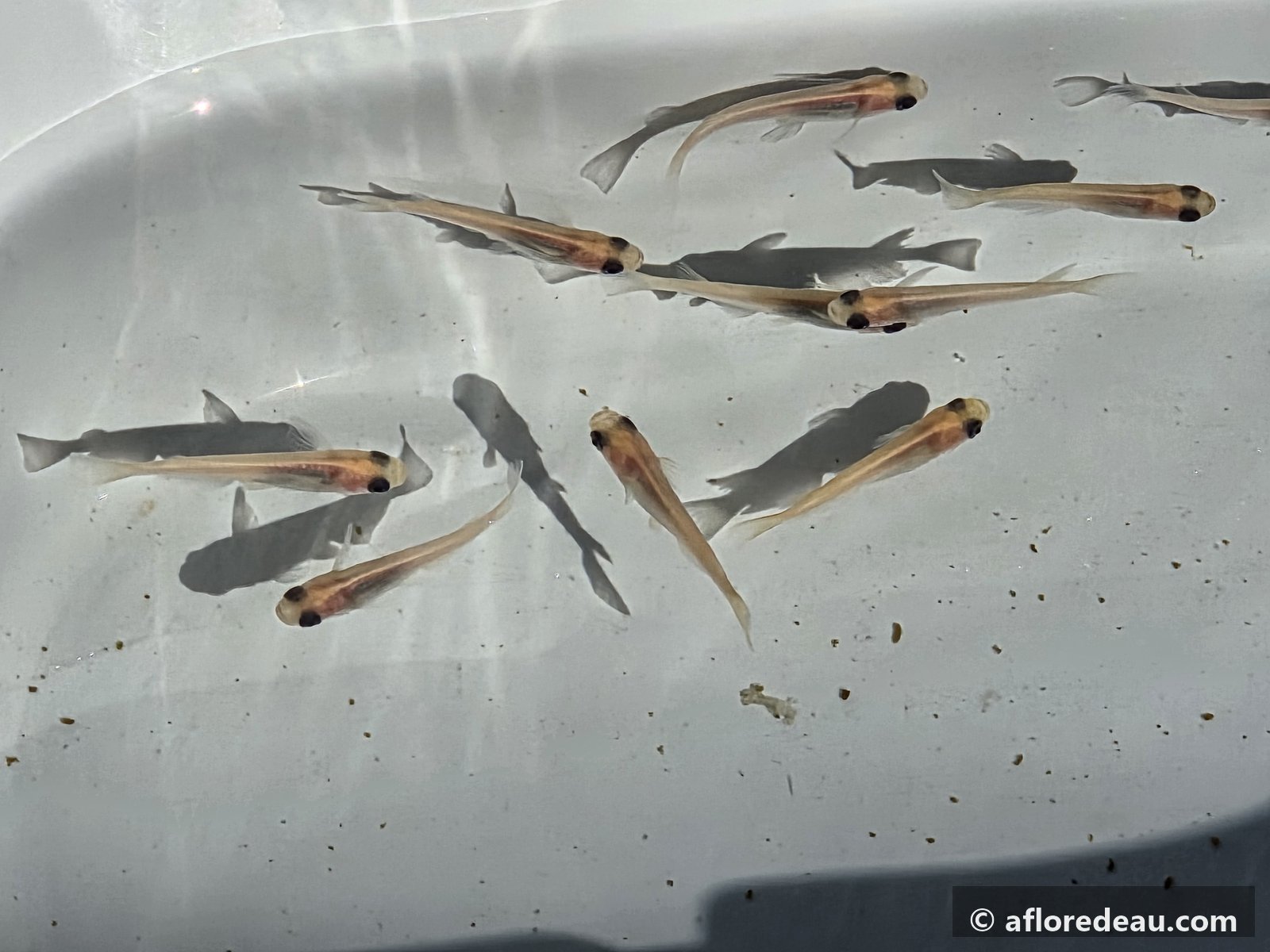
Yes for the adults, no for breeding. Notropis chrosomus, the rainbow shiner of the pond catalogues, is a peaceful little cyprinid of 5 to 8 cm with neither the mouth nor the temperament to attack an adult medaka. In a real pond, the two species live side by side. But the shiner eats everything that drifts within reach, medaka eggs and fry included, it wants current and oxygen where the medaka wants calm water, and it has to be kept in groups of ten in several hundred litres. The result: medaka that survive without renewing themselves, and a mixed community that suits a garden pond only, never a tub or a tank.
Who the Notropis chrosomus is
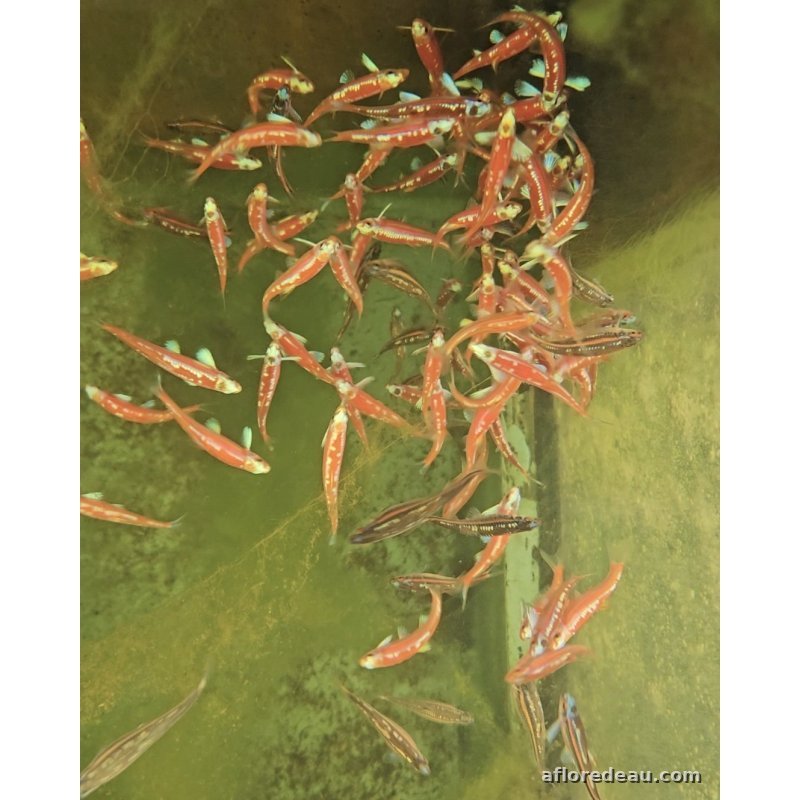
It is a river fish from the south-east of the United States, from the clear, stony streams of the Mobile basin in Alabama and Georgia. In English it is the rainbow shiner; French sources call it cyprin, méné or vairon arc-en-ciel. It measures 5 cm on average, 8 cm at most, and lives three to five years. Out of season, it is a rather ordinary little silver fish. At spawning time, in May and June, the males take on a purple head and back and metallic blue flanks edged with pink: it is for that month that people buy it.
Two traits matter for our subject. It lives in a tight shoal in open water, very active, an excellent swimmer, and every fact sheet asks for it to be kept in groups of ten or fifteen, in 120 to 180 litres at the very least. And it is made for current: clear water, strong circulation, high oxygenation, all the more so as the water is warm. It is a stream fish, not a pond fish.
The two fish side by side
| Medaka | Notropis chrosomus | |
|---|---|---|
| Adult size | 3 to 4 cm | 5 to 8 cm |
| Swimming zone | surface and shallow edges | open water, in the current |
| Water | calm, planted, no current, warm in summer | flowing, clear, highly oxygenated, cool |
| Temperature | from ice to over 30 °C | 5 to 25 °C according to B-Aqua; suffers above that |
| Social life | small group, a 20 L tub is enough | shoal of 10 to 15, 120 to 180 L at the very least |
| Diet | surface insects, micro-organisms | drifting insects and invertebrates, eggs included |
| Spawning | eggs stuck to plants, May to September | eggs scattered over gravel, May to June, eaten by the parents |
What happens when you put them together
The adults tolerate each other. The Notropis is described everywhere as peaceful, non-territorial and indifferent to other species. Its mouth is small; an adult medaka of 3.5 cm does not fit in it. No chasing or harassment is observed, which sets it clearly apart from the goldfish, which we discussed in medaka and goldfish. On this specific point, Tokyo Aqua Garden’s criterion is met: the species cannot swallow a medaka.
The eggs and fry, however, do not get through. The Notropis feeds on whatever drifts in the current and whatever it finds on plants; the fact sheets note that it eats its own eggs as soon as they are laid. A medaka egg hanging on a floating root, a 5 mm fry staying just under the surface, is exactly its meal. With a shoal of ten Notropis patrolling all day, no medaka fry reaches adulthood. The medaka population does not renew itself, and in three or four years none are left.
Food goes to the fastest. A shoal of Notropis throws itself on anything that falls into the water. The medaka is slower, shyer, and feeds at the surface at the edge. If you feed in the same place, the medaka get the leftovers. You need two feeding points far apart, the first in the current to occupy the shoal, the second in the calm zone for the medaka, and you have to check that they really eat.
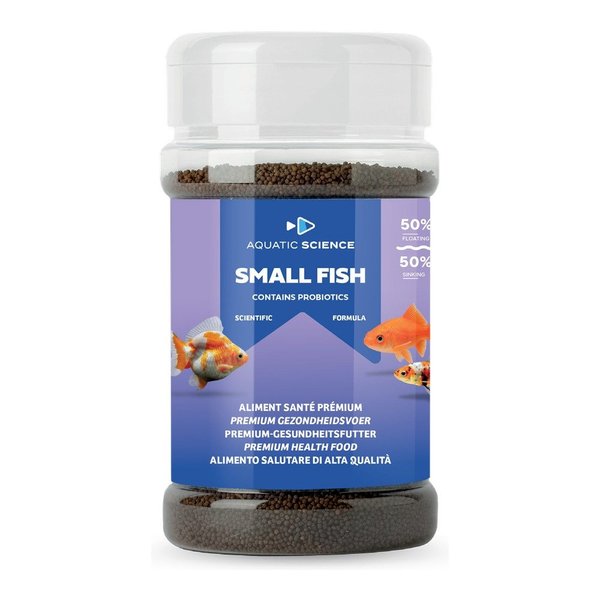
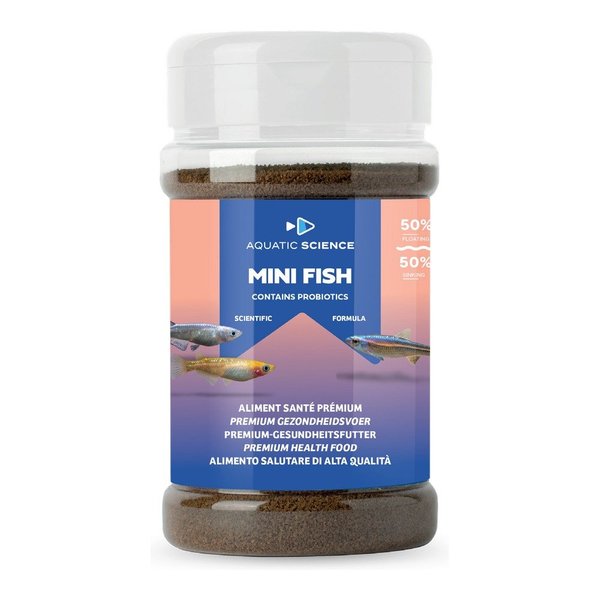
The grain size can also differ from one point to the other. Aquatic Science’s Small Fish, a 1.1 mm pellet intended for Notropis and goldfish, suits the shoal; the medaka keep a fine grain, such as the same brand’s Mini Fish, at 0.3 mm. See our introduction to the range.
They do not want the same water. This is the real problem. The Notropis needs strong circulation and oxygen-rich water, and the fact sheets insist: the warmer the water, the more oxygen it needs, with a ceiling around 25 °C. The medaka wants the opposite: calm, shallow, planted water that warms quickly in the sun, where it spawns on floating roots; a permanent current tires it and scatters its eggs. In a single tank, one of the two is sacrificed. In a pond, each can be given its own zone, and that is the only set-up that works.
Summer settles it. A pond 60 cm deep in lowland country spends a good part of July and August between 24 and 28 °C at the surface. The medaka copes, the Notropis does not: it comes up to breathe at the surface, loses weight, and this is the season when it is lost. In the Mediterranean south, the matter is settled before it has begun; in Atlantic or northern Europe it can work, provided a waterfall or an air diffuser runs all summer.
In which pond it works
The mix only works if the pond offers both habitats. Allow at least one cubic metre of water, and preferably two: the Notropis shoal alone demands the equivalent of a large aquarium, and B-Aqua’s rule is to add up the volumes for each species. You need a flowing zone, a filter outlet or a small stream over a gravel bed, where the shoal spends its days and may spawn in June; and a shallow cove, 20 to 30 cm deep, densely planted, with no current, exposed to the morning sun, where the medaka stay, spawn and warm up. The more cluttered with plants this cove is, the more a few fry escape the shoal; do not count on it, however. And a fine net over the top, because a pond that attracts medaka also attracts the heron and the kingfisher.
If you are set on keeping both species and on having medaka fry, the solution is the same as on all our pages about cohabitation: two bodies of water. The pond with the Notropis, with its waterfall; a tub or a container of 20 litres or more beside it, for the medaka, as described in keeping medaka outdoors. Collect the eggs there, hatch them separately following raising medaka fry, and release the young into the pond once they exceed 2 cm, a size at which a Notropis no longer troubles them. It is the only way to have a mixed pond that lasts in the same garden.
In a tub, a bowl or a Medaka Bowl: no
The question does not even arise. A single Notropis wastes away, a shoal of ten in 40 or 80 litres with no current suffocates at the first hot spell, and it will have eaten all the fry before that. The medaka tub stays a medaka tub, with only shrimp and snails for company (see what animals to keep with medaka).
Winter
The Notropis is a cold-water fish: the fact sheets say it is comfortable down to 10 °C in an unheated aquarium and B-Aqua puts its floor at around 5 °C, without quantifying survival under ice. We keep them outside in Lesneven: they get through the Finistère winter without a problem, in a pond that freezes over at the surface a few days a year. For a continental winter, allow at least 80 cm of depth and a hole in the ice, as for any pond. The medaka, for its part, overwinters without difficulty in the same water: see overwintering medaka.
Two precautions that are not up for discussion
A Notropis reaches you through the trade, sometimes from intensive farms; B-Aqua reports deformed fish and fragile batches. Quarantine of three weeks in a separate tank before putting it with anything, medaka included. And as with the medaka, never release it: the species is not on the European Union list of invasive alien species, but it is a North American fish that has no business in a European stream. The reminder applies to both: releasing a medaka into the wild.
The markers to remember
| Adults together | yes: peaceful, mouth too small for an adult medaka |
|---|---|
| Medaka eggs and fry | eaten; no renewal of the population |
| Volume | pond of 1,000 L or more, with a flowing zone and a calm planted cove |
| Tub, bowl, Medaka Bowl | no |
| Summer | the Notropis suffers above 25 °C: permanent circulation, not in the Mediterranean south |
| To keep fry | two bodies of water: the mixed pond, a rearing tub beside it |
| Before introducing | three-week quarantine; never release |
Frequently asked questions
My medaka have been in the pond with Notropis for two years and all is well. Why do you say no?
We do not say no for the adults. Count your medaka and look for a young fish of the year: if there are none, the population is ageing with no replacements, and the pond will be without medaka in two or three years. That is what we call “surviving without living”.
What about just one or two Notropis, for the colour?
A lone Notropis is stressed, sickly and without colour: it is the shoal that makes it turn blue in spring. One or two is the worst solution for it and changes nothing for the medaka fry.
Does the Notropis eat mosquitoes like the medaka?
Yes, it is an insectivore and takes the larvae that pass in the current. But it does not replace the medaka in calm, shallow zones, where mosquitoes lay: see medaka and mosquitoes.
Can there be hybrids?
No. The medaka is a ricefish of the family Adrianichthyidae, the Notropis a cyprinid: no crossing is possible. The Notropis can, however, hybridise with other Notropis, one more reason never to release it.
Sources
- Fishipedia, fact sheet Notropis chrosomus, rainbow cyprinid (in French): size, 1 to 30 °C, shoal of ten in 120 L, spawning from May to June, strong current and oxygenated water, fishipedia.fr.
- B-Aqua, fact sheet Rainbow shiner (in French): 5 to 25 °C, strong circulation, fifteen individuals in 180 to 250 L, eggs eaten by the adults, overwintering in a cold aquarium, deformities in intensively farmed fish, b-aqua.com.
- Practical Fishkeeping, Rainbow shiner: a drift-feeding fish, eats its own eggs, cool water down to 10 °C, practicalfishkeeping.co.uk.
- FishBase, Notropis chrosomus: distribution and maximum size, fishbase.se.
- Tokyo Aqua Garden, メダカと一緒に飼える魚や生き物は何がいる? (which fish and animals can be kept with medaka?): the criteria for a good medaka companion, t-aquagarden.com.